In-House vs. Outsourced Teleradiology: A Cost & Coverage Comparison

For imaging centers and hospitals, one of the more consequential operational decisions is whether to handle radiology coverage in-house or outsource it to a teleradiology provider. Both models can deliver high-quality interpretation; they differ in cost structure, coverage flexibility, and control. This guide compares them across the dimensions that matter most, so you can decide which fits your facility—or whether a blend of both is the right answer.
The Two Models in Brief
In-house coverage means employing radiologists directly, whether reading on site or remotely under your own roof. You carry the staffing, but you also retain full control. Outsourced teleradiology means contracting with an external provider that supplies remote radiologists to interpret your studies, typically priced per study or per coverage period. Many facilities use a hybrid: in-house radiologists for core daytime volume, outsourced teleradiology for nights, weekends, overflow, or subspecialty reads.
Cost Comparison
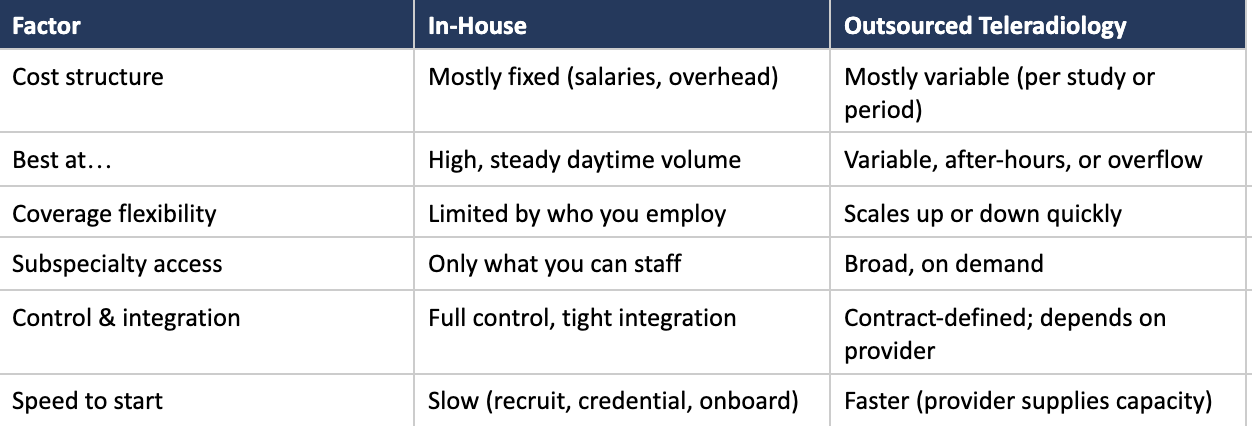
The cost structures are fundamentally different. In-house coverage is largely a fixed cost: salaries, benefits, and overhead are paid regardless of daily volume. That is efficient at high, steady volume—but expensive when demand is variable or when coverage is needed during low-volume hours. Outsourced teleradiology is typically a variable cost that scales with usage, which suits fluctuating or after-hours demand but can become costly at very high sustained volume.
Simplified, the tradeoff looks like this:
Coverage and Flexibility
Coverage is where outsourcing often shines. An external provider can extend interpretation to nights, weekends, and holidays without your facility maintaining an overnight roster, and can absorb volume spikes or provide subspecialty reads on demand. In-house coverage offers less elasticity—you are limited by the radiologists you employ—but delivers deeper familiarity with your protocols, systems, and referring physicians.
Quality and Control
Quality can be excellent in either model, but the levers differ. In-house teams offer tight integration, consistent standards you set directly, and easy face-to-face coordination. With outsourcing, quality depends on the provider’s credentialing, turnaround commitments, and communication protocols—which is why the service agreement matters so much. The key is not which model is inherently better, but whether the arrangement is structured to meet your standards.
How to Decide
The right choice depends on your specific situation. Consider:
- Volume and its pattern: High and steady favors in-house; variable or concentrated after-hours favors outsourcing.
- Coverage hours: If you need nights, weekends, or holidays covered, outsourcing is usually more economical than staffing them in-house.
- Subspecialty needs: If you need reads you cannot staff, outsourcing provides access without a full-time hire.
- Control requirements: If tight integration and direct oversight are priorities, in-house or a carefully structured hybrid may fit better.
- Speed: If you need coverage soon, outsourcing starts faster than recruiting and credentialing.
The Supervision Dimension
This comparison covers image interpretation—but for outpatient imaging centers, there is a parallel decision about supervision of contrast-enhanced studies. Just as reads can be handled in-house or outsourced, contrast supervision can be provided by an on-site physician or through remote coverage. And the economics often point the same way: maintaining on-site physician supervision for every operating hour is a fixed cost that variable or after-hours demand rarely justifies.
ContrastConnect provides virtual contrast coverage—outsourced, remotely delivered physician supervision of contrast administration—on the same logic that makes outsourced teleradiology attractive: flexible, scalable coverage without the fixed cost of on-site presence at every hour. For facilities weighing in-house versus outsourced reads, the supervision question is worth evaluating in parallel.
Trusted Nationwide


















.avif)




1,000,000
Contrast exams supervised annually
75,000+
Hours of supervision monthly
3,900+
Technologists certified
100s
Of imaging partners nationwide
130+
Contrast reactions treated monthly
100%
Requested hours covered
Connect with us.

