Virtual Contrast Supervision by Facility Type


Virtual contrast supervision solves the same underlying problem everywhere: contrast studies require physician availability, and physician availability is expensive and difficult to maintain on site. But what that problem looks like — and what a coverage model needs to do about it — varies considerably by facility type.
This guide covers how the model applies across the four settings where it is most commonly adopted, and what differs between them.
This article is general operational information. It is not legal, compliance, or clinical advice. Supervision requirements can differ by facility type and by state — confirm what applies to your organization with your own compliance and legal professionals.
Freestanding Outpatient Imaging Centers
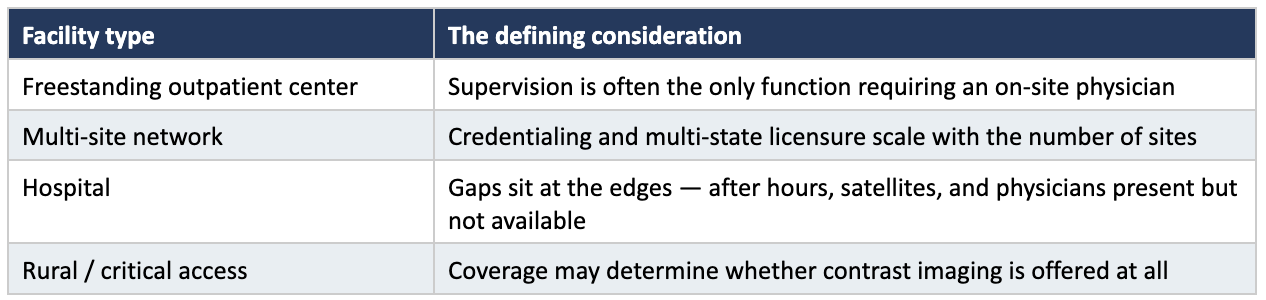
This is the setting where the constraint bites hardest. An independent imaging center typically has strong contrast volume but no natural reason to employ a physician on site all day, because supervision is often the only function requiring one. The result is the familiar pattern: contrast studies restricted to certain days, patients scheduled out, or contrast declined altogether.
Remote supervision addresses this directly by supplying the one function that required a physical presence. For a center where supervision is genuinely the binding constraint, the effect on available contrast capacity can be immediate.
Multi-Site Networks
For organizations running several locations, the difficulty is not any single site but the arithmetic across them. Staffing physician coverage at every location for every operating hour is rarely viable, so networks tend to concentrate contrast services at a few sites and route patients there — which costs capacity at the other locations and convenience for patients.
A remote model changes the arithmetic, but introduces its own considerations:
- Credentialing multiplies. Supervising physicians generally need credentialing at each facility they cover, so a pool of physicians across a network of sites is a real administrative load. Credentialing by proxy, where available, is what makes this manageable.
- Licensure follows the patient. Networks crossing state lines need physicians licensed in each state where patients are located.
- Rules may differ by state. A coverage model permissible in one state may not be in another; uniform assumptions are the risk.
- Protocol consistency. Standardizing how supervision is requested, established, and documented across sites prevents each location developing its own practice.
Hospitals
Hospitals usually have physicians on site, which leads to an assumption that supervision is covered. Often it is — during core hours, in the main department. The gaps appear at the edges: evenings and weekends, outpatient imaging attached to but separate from the main department, satellite locations under the hospital’s license, and periods when the physicians present are committed elsewhere and not genuinely available.
Being in the building is not the same as being immediately available. A physician occupied with a procedure that cannot be interrupted does not satisfy the requirement, which is why hospitals sometimes have supervision gaps despite having no shortage of physicians on the premises. Requirements can also differ between hospital outpatient departments and freestanding facilities, so the applicable standard is worth confirming per setting rather than assuming one rule covers the organization.
Rural and Critical Access Facilities
In rural settings the equation is starkest. Recruiting and retaining physicians is hardest exactly where volume is thinnest, so the fixed cost of on-site coverage is least supportable in the places least able to absorb it. The practical consequence is that patients travel — sometimes considerable distances — for a contrast study their local facility is otherwise fully equipped to perform.
Remote supervision is often what makes contrast imaging viable at these sites at all, rather than merely more efficient. The considerations that matter most here are connectivity reliability and having a workable contingency protocol, since the fallback options are thinner than in a metropolitan setting.
What Differs, Summarized
Coverage Without a Full-Time Hire
Across all four settings, the recurring question is whether the supervision requirement justifies employing a physician. Framed as a binary — hire someone or do not offer contrast — many facilities are stuck with an answer they dislike either way.
Remote coverage reframes it as a question of matching availability to need: coverage during the hours contrast studies actually occur, at the locations where they occur, without carrying the cost during the hours they do not. That is a different question from whether to add headcount, and for most facilities it has a clearer answer.
How ContrastConnect Works Across Settings
ContrastConnect provides remote physician supervision of contrast administration across outpatient centers, multi-site networks, hospitals, and rural facilities. What changes between them is the shape of the coverage — which hours, which locations, how many physicians, and how credentialing is handled at scale. The requirement being met is the same in each case; the model is built around where the gap actually sits.
Trusted Nationwide


















.avif)




1,000,000
Contrast exams supervised annually
75,000+
Hours of supervision monthly
4,100+
Technologists certified
500+
Imaging partners nationwide
130+
Contrast reactions treated monthly
100%
Requested hours covered
Connect with us.

