Which States Have Enacted Virtual Contrast Supervision Laws? A Running Tracker


Last updated: April 2026. This article is updated as new state legislation is enacted or regulatory changes take effect. Bookmark it and check back when your state’s legislative session is active.
The federal CMS permanent rule effective January 1, 2026 established virtual direct supervision as a legally compliant form of physician oversight for Level 2 diagnostic tests — including contrast-enhanced CT and MRI — across all Medicare-participating facilities in the country. That rule is the national floor.
But state law is a separate layer. Before the CMS permanent rule existed, many states had their own statutes defining what “direct supervision” required for contrast administration — and some of those statutes required physical on-site physician presence regardless of what CMS permitted. A facility that satisfies the federal standard may still be non-compliant with its state’s medical practice act or radiologic technology statute if that state’s rules have not been updated.
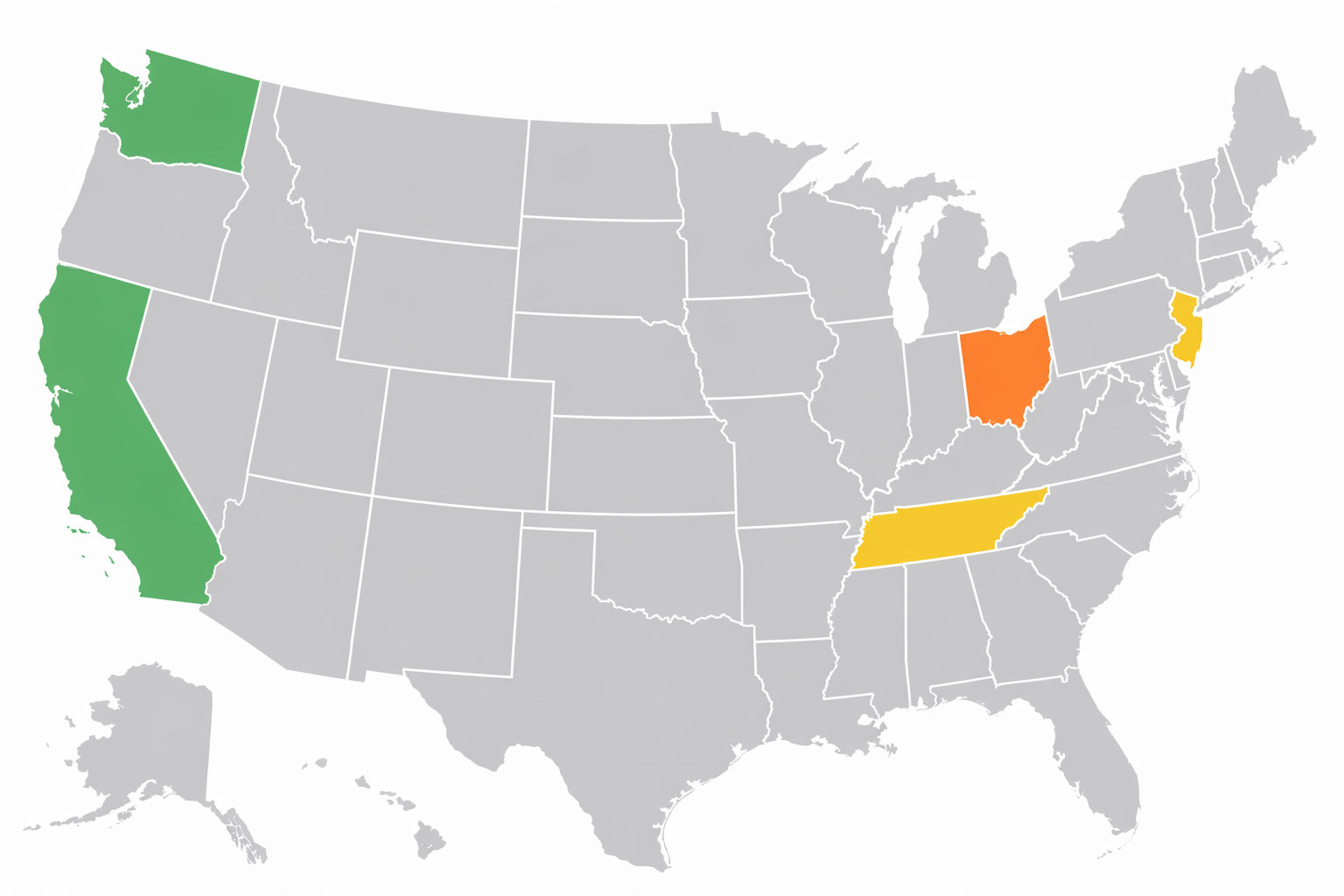
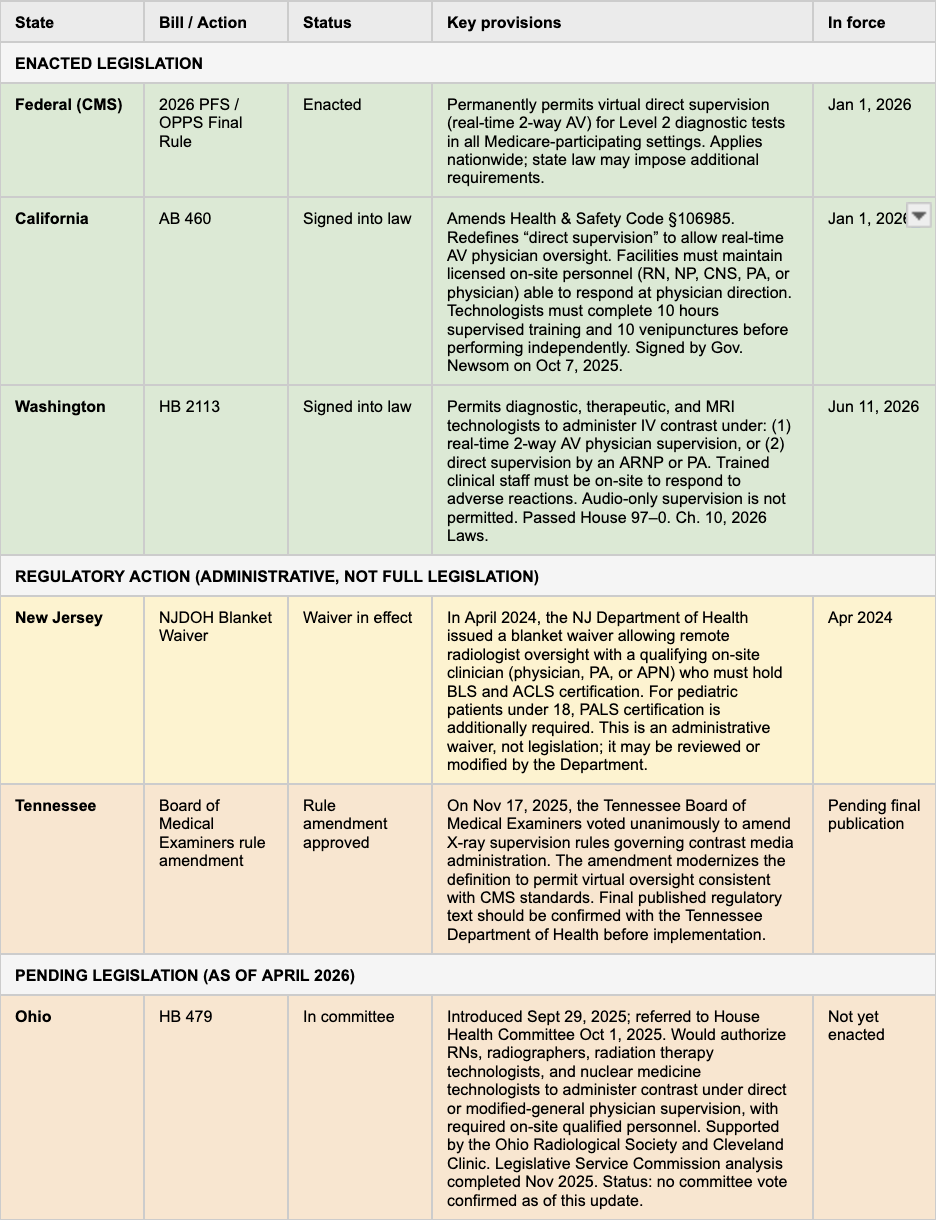
This tracker documents the current legislative and regulatory status of virtual contrast supervision in states that have taken formal action — through enacted legislation, regulatory amendment, or administrative waiver — as well as states where bills are pending. For all other states, the CMS permanent rule applies and no additional state-level constraint is currently verified.
Important: This tracker covers formal state-level legal action specifically addressing virtual or remote contrast supervision. It is not a substitute for legal counsel. Facilities should confirm compliance with their state’s current statutes and any regulatory guidance issued by state health departments or medical boards before implementing a virtual supervision program.
State-by-State Tracker
How Federal and State Law Interact
For facilities operating under Medicare, the CMS permanent rule is the minimum compliance standard. If your state has enacted legislation or regulatory guidance that is more permissive than or equivalent to the federal standard, the CMS rule governs.
If your state’s existing statute requires physical on-site physician presence — and that statute has not yet been updated — the more restrictive state law may apply for non-Medicare services or in specific regulatory contexts. The key question is whether your state’s medical practice act, radiologic technology statute, or Department of Health rules contain language that would conflict with virtual supervision even under the federal CMS framework.
This is why the state-level legislative movement matters. California’s AB 460 and Washington’s HB 2113 did not create a new standard — they brought state law into alignment with what CMS had already authorized federally. Facilities in those states can now operate a compliant virtual supervision program with confidence that both layers are aligned.
For states not listed in this tracker, the CMS permanent rule applies to Medicare-participating facilities. ContrastConnect provides state-specific compliance guidance as part of the onboarding process for new imaging center partners.
What to Watch for in Your State
State legislative activity on virtual contrast supervision is accelerating. A few signals that your state may be moving toward formal action:
- Your state radiological society has published a policy position supporting virtual supervision alignment with CMS standards
- Your state’s board of medical examiners or Department of Health has initiated a rulemaking review of radiologic technologist supervision statutes
- A state legislator with a healthcare or rural access focus has introduced a workforce modernization bill that touches radiologic procedures
- Your facility’s legal counsel has flagged an apparent conflict between your state’s existing radiologic technology act and the CMS permanent rule
If any of these apply, the state tracker on this page will be updated as formal action is taken. ContrastConnect monitors state-level developments as part of our ongoing compliance support for imaging center partners.
The Landscape Is Still Evolving
As of April 2026, two states have enacted full legislation explicitly recognizing virtual contrast supervision — California and Washington — and two others have taken meaningful regulatory action through administrative channels. The federal CMS permanent rule provides the baseline for all Medicare facilities. Additional states are expected to follow as awareness of the CMS change grows and state legislatures revisit outdated radiologic technologist supervision statutes.
ContrastConnect tracks this landscape actively because our imaging center partners need to know where they stand — not just federally, but in their specific state. If you have questions about compliance in your state, our team can walk you through the current picture.
Trusted Nationwide

















.avif)




1,000,000
Contrast exams supervised annually
75,000+
Hours of supervision monthly
3,900+
Technologists certified
100s
Of imaging partners nationwide
130+
Contrast reactions treated monthly
100%
Requested hours covered
Connect with us.

