Implementing Virtual Contrast Supervision: Selection, Onboarding, and Transition


Adopting virtual contrast supervision is less a technology decision than an operational one. The connection itself is straightforward; what determines whether an implementation goes smoothly is everything around it — provider selection, credentialing lead time, protocol alignment, staff readiness, and having thought about what happens if the arrangement ever needs to change.
This guide walks through implementation end to end, from evaluating providers through go-live and beyond.
This article is general operational guidance. It is not legal, compliance, or clinical advice. Confirm requirements applicable to your facility with your own compliance, legal, and clinical leadership.
Stage 1: Selecting a Provider
Providers differ more than the category suggests. The criteria that separate them:
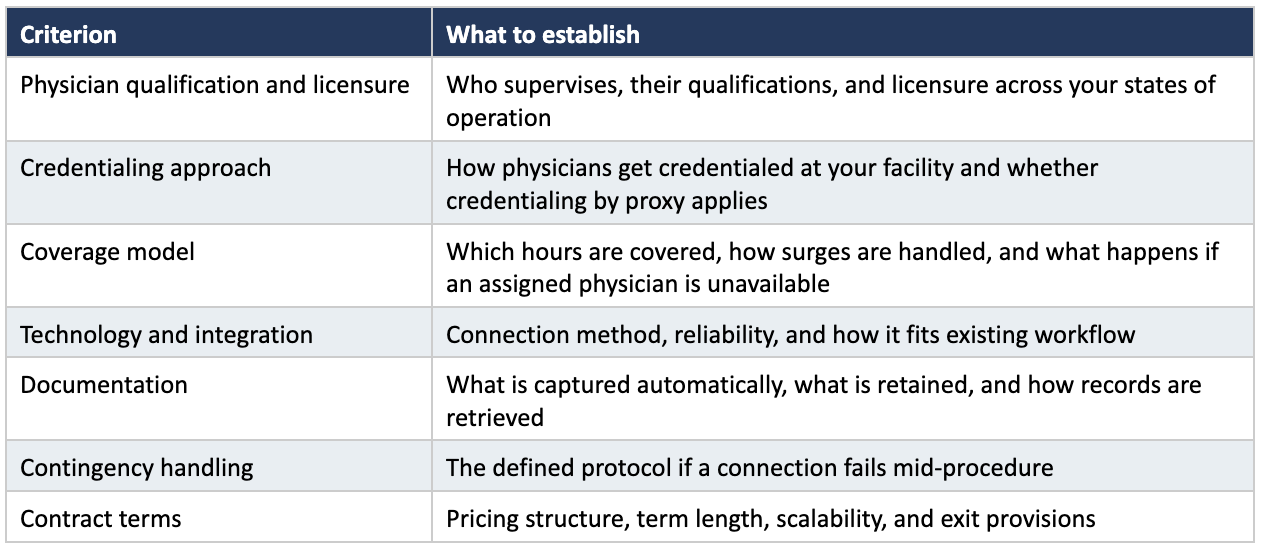
The two criteria most often skipped in evaluation are documentation and exit provisions. Both are easy to overlook while everything is working and difficult to remedy afterward.
Stage 2: Confirming What Applies to You
Before onboarding begins, establish the regulatory picture for your specific situation: which supervision level applies to your procedures, whether remote supervision is permitted in each state where you operate, which practitioners may supervise under your state’s scope-of-practice rules, and what your facility policy requires beyond that. Where these layers differ, the most restrictive generally governs.
Doing this before rather than during implementation avoids the most common cause of delay — discovering a jurisdictional constraint after the coverage model has been designed around a different assumption.
Stage 3: Onboarding
Onboarding runs on several parallel tracks, and the longest one usually sets the timeline:
- Credentialing and privileging. Almost always the critical path. Supervising physicians must be credentialed at each facility they cover, and verification depends on third parties responding. Start this first.
- Technical setup. Connection, hardware placement, network reliability, and confirmation that the setup works from the rooms where contrast is actually administered — not just from the office.
- Protocol alignment. Written procedures updated to reflect how supervision is requested, established, and documented.
- Documentation workflow. Confirming what the platform captures, what staff must enter, and where records live.
- Staff training. Covered separately below, because it is the track most often underestimated.
Stage 4: Preparing Technologists
In a virtual model, the on-site technologist’s role expands. They remain responsible for patient preparation and contrast administration, and they also become the physician’s eyes and hands — establishing the connection, communicating what they observe, and executing direction during an event.
Training should cover, at minimum:
- How to establish and verify the supervision connection before contrast is administered.
- How to communicate patient status clearly to a physician who cannot see the room unaided.
- What to do if the connection fails mid-procedure.
- How the escalation path works, including when to summon emergency services.
- What they are responsible for documenting.
Running through the contingency scenario in practice — not just describing it in a policy — is what separates a protocol that works from one that exists.
Stage 5: Go-Live and Early Monitoring
Most facilities benefit from starting narrow: one site, one modality, or a defined block of hours, with deliberate review before expanding. The first weeks should surface the practical issues — connection reliability in specific rooms, documentation gaps, communication friction — while the volume is small enough to fix them easily.
Review documentation early rather than at the first audit. A sample check in week two tells you whether the record is capturing what it should, at a point when correcting the workflow costs nothing.
Changing Providers
Transitions carry risks that are straightforward to manage if anticipated and awkward otherwise. The main ones:
- Coverage continuity. New physicians need credentialing at your facility before they can supervise — which means overlapping the old and new arrangements rather than switching on a date.
- Historical records. Supervision documentation from the prior arrangement must remain accessible to you after the relationship ends.
- Protocol and training updates. Connection methods and workflows differ between providers; staff need re-training rather than assumption of transfer.
Planning for Exit at the Start
The most useful time to establish exit terms is during selection, when you have leverage and no urgency. Worth settling up front: who owns the supervision records, how you obtain them, what notice period applies, and whether coverage continues during a transition.
None of this signals distrust of a provider. It is the same reasoning that makes any vendor relationship easier to manage — and in this case the records involved are ones you may need to produce long after the relationship ends.
How ContrastConnect Approaches Implementation
ContrastConnect treats credentialing, technical setup, protocol alignment, and staff preparation as part of implementation rather than as the facility’s problem to solve alone. For organizations evaluating providers, the questions above are the ones worth asking of anyone — including us — before signing rather than after.
Trusted Nationwide


















.avif)




1,000,000
Contrast exams supervised annually
75,000+
Hours of supervision monthly
4,100+
Technologists certified
100s
Of imaging partners nationwide
130+
Contrast reactions treated monthly
100%
Requested hours covered
Connect with us.

