The ACR Manual on Contrast Media


The ACR Manual on Contrast Media is the reference standard for contrast safety in the United States. Published by the American College of Radiology and updated periodically by its Committee on Drugs and Contrast Media, it is the document imaging departments build their contrast policies around — covering how to screen patients, how to prevent adverse events, and how to recognize and manage reactions when they occur.
This guide explains what the Manual covers, how it is organized, and how imaging teams apply it operationally. It is an orientation to the document, not a substitute for it: the Manual itself should be your source of record.
This article summarizes the general structure and subject matter of the ACR Manual on Contrast Media for orientation purposes. It is not clinical guidance and does not reproduce the Manual’s recommendations. Always consult the current edition of the Manual directly, along with your institution’s protocols, for clinical decision-making.
What the ACR Manual on Contrast Media Is
The Manual is a consensus document rather than a regulation. It carries no direct force of law, yet it functions as the de facto standard of care for contrast administration — which means departures from it tend to require justification, and alignment with it is what most institutional policies aim for. It is developed and revised by the ACR Committee on Drugs and Contrast Media and made available publicly by the ACR.
Its audience is the full imaging team, not only radiologists: technologists administering contrast, nurses managing reactions, supervising physicians, and the administrators writing departmental policy all work from it.
What the Manual Covers
The Manual is organized around the practical questions that arise before, during, and after contrast administration. Its principal subject areas include:
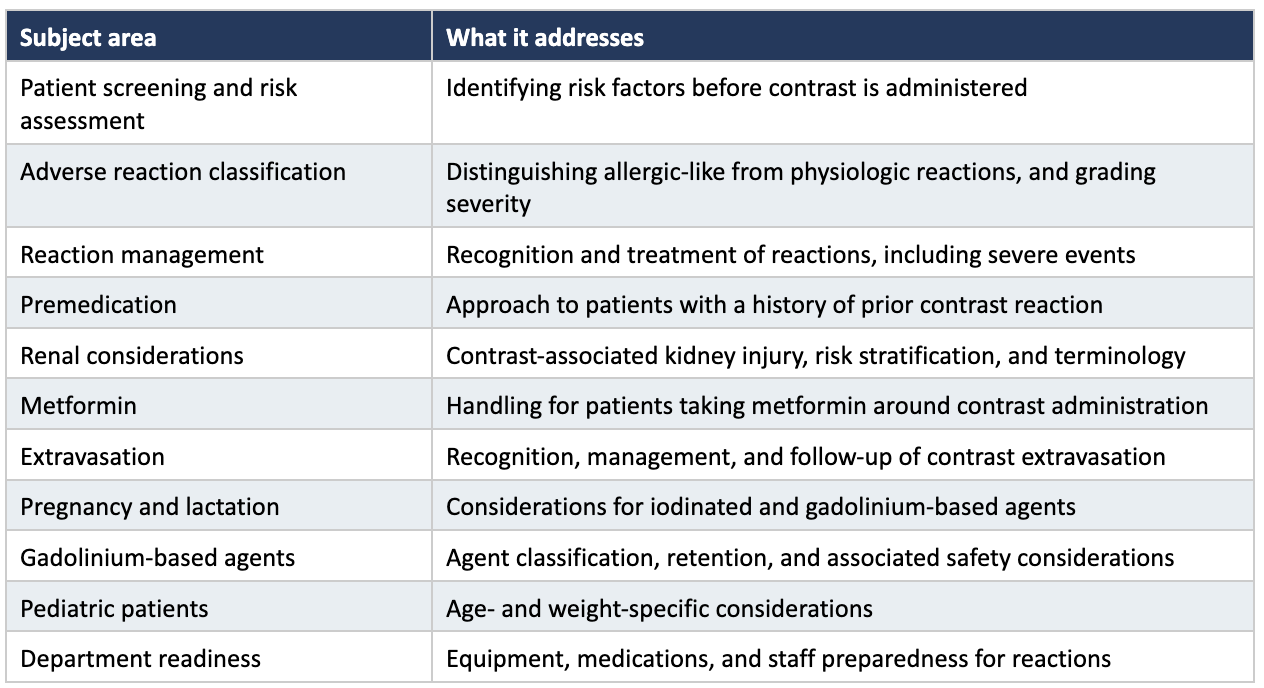
Because the specifics within each area — thresholds, regimens, dosing, and agent classifications — are revised between editions, they should be read directly from the current Manual rather than from any summary, including this one.
How Imaging Teams Actually Use It
In practice, the Manual tends to be used in four distinct ways, and it helps to be deliberate about which one you are doing:
- Policy foundation. Departmental contrast protocols are written to align with it, then reviewed when a new edition is released.
- Screening design. Intake questionnaires and risk-assessment workflows are built from its risk factors.
- Reaction preparedness. Reaction kit contents, staff training, and response algorithms are derived from its management guidance.
- Point-of-question reference. Staff consult it when an individual case raises a question the local protocol does not answer.
The failure mode worth guarding against is policy drift: a department writes its protocol against one edition, the Manual is revised, and the local document quietly becomes out of date. Tying a protocol review to each new edition release is the simplest defense.
The Supervision Dimension
One thread running through the Manual’s reaction-management content has direct operational consequences: managing a contrast reaction requires someone qualified to be available when it happens. Preparedness is not only about having the right medications in the right drawer — it is about physician availability during administration.
This is where contrast safety and supervision requirements meet. A department can be fully aligned with the Manual on protocol and equipment and still have a gap if the required direct supervision is not reliably available during the hours contrast studies are performed. Reaction readiness on paper and reaction readiness in practice are different things, and the difference is usually availability.
Where to Access It
The ACR makes the Manual on Contrast Media publicly available through its website, and it is worth working from the official source rather than a cached copy or a third-party summary — including this page. Because editions supersede one another, confirm you are reading the current version, and check whether a newer edition has been released before relying on a downloaded PDF.
How ContrastConnect Fits
ContrastConnect provides remote physician supervision of contrast administration — the availability side of the reaction-readiness equation. For departments whose protocols align with the ACR Manual but whose supervision coverage does not extend across every location and operating hour, that gap is where preparedness breaks down in practice. Closing it is what the service exists to do.
Trusted Nationwide
















.avif)




1,000,000
Contrast exams supervised annually
75,000+
Hours of supervision monthly
3,900+
Technologists certified
100s
Of imaging partners nationwide
130+
Contrast reactions treated monthly
100%
Requested hours covered
Connect with us.

