Teleradiology Jobs in 2026: What the Field Looks Like and Why Supervision Roles Are Growing


Teleradiology Jobs in 2026: What the Field Looks Like and Why Supervision Roles Are Growing
Teleradiology has moved from a niche coverage solution to one of the defining structures of the radiology job market. Remote reading is no longer a supplement to a radiologist’s primary on-site role. For a growing share of radiologists, it is the primary role. If you are a radiologist evaluating where the field is heading, or an imaging center administrator trying to understand how remote radiology work is reshaping coverage, here is the current picture as of 2026.
The Teleradiology Market Is Growing Fast
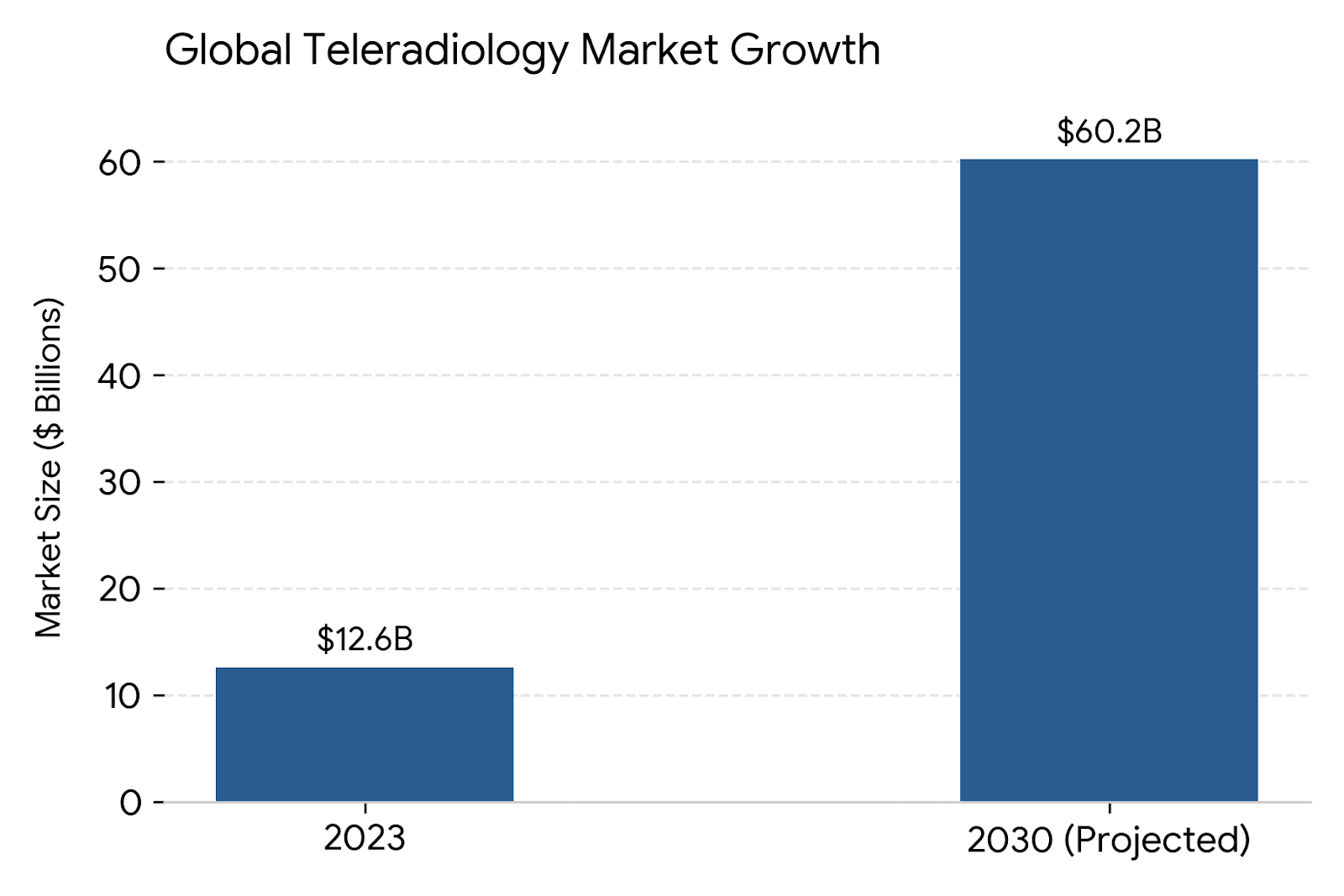
The numbers tell a clear story. The global teleradiology market was valued at roughly $12.6 billion in 2023 and is projected to reach more than $60 billion by 2030, a compound annual growth rate above 25%. That growth reflects a structural shift in how radiology work is organized, not just a temporary post-pandemic adjustment.
The shift shows up directly in hiring. According to 2026 radiology job market analysis, roughly one in four US radiology positions is now fully remote-capable. Job boards run by the American College of Radiology and major staffing firms list teleradiology positions prominently, with compensation for remote diagnostic roles frequently ranging from the mid-$350,000s to over $575,000 depending on subspecialty, volume, and shift structure.
Underlying this growth is a basic supply-demand imbalance. The United States now processes roughly one billion diagnostic imaging studies per year, and imaging volume continues to grow with an aging population. Meanwhile, the Bureau of Labor Statistics projects radiologist headcount to grow only modestly, from approximately 28,200 positions in 2024 to around 29,000 by 2034. Demand for imaging interpretation is outpacing the growth of the radiologist workforce, and teleradiology is the mechanism the field is using to stretch existing capacity across more facilities.
What Teleradiology Jobs Actually Look Like
Teleradiology roles vary widely in structure, and understanding the categories helps both job seekers and administrators evaluating coverage options.
Full-time remote reading
Many teleradiology positions are full-time remote roles in which the radiologist reads studies from home or a remote workstation, often for a large group or a dedicated teleradiology company. These roles offer location independence and schedule flexibility, with common structures including 7-days-on/14-days-off rotations and night-only or evening-only shifts. The tradeoff, as several radiology recruiters note, is reduced in-person collaboration and limited access to leadership or academic pathways.
Off-hours and nighthawk coverage
A significant portion of teleradiology demand is concentrated in overnight, weekend, and holiday coverage, the hours when on-site radiologists are hardest to staff. These nighthawk roles have historically been a core teleradiology function. Interestingly, 2026 market data shows that overnight roles carry a slight salary discount relative to day-only positions, around $455,000 versus $500,000 median, reflecting how many radiologists now prefer the flexibility of remote work even at off-hours.
Subspecialty remote reading
Teleradiology has made it possible for subspecialists, neuroradiologists, musculoskeletal radiologists, pediatric radiologists, to serve multiple facilities that could not individually justify a full-time subspecialist on staff. A neuroradiologist can read for several academic centers simultaneously from a single remote workstation.
How AI Is Changing the Picture, and What It Is Not Changing
No discussion of radiology jobs in 2026 is complete without addressing artificial intelligence. Radiology has more FDA-cleared AI devices than all other medical specialties combined, and AI tools are increasingly capable of automating routine reads, plain films and basic cross-sectional interpretation in particular.
The effect on the job market has been the opposite of what was predicted a decade ago. Rather than eliminating radiologists, AI has shifted value toward the work it cannot do: complex interpretation, procedural work, clinical integration, and direct involvement in patient care. The radiologists thriving in 2026 are not reading more commodity studies. They are reading harder ones, performing procedures, and integrating with care teams.
This matters for understanding where teleradiology is heading. As AI absorbs more of the routine reading volume, the human radiologist’s value concentrates in the functions that require judgment, presence, and real-time clinical involvement. One of those functions is physician supervision of contrast administration.

Why Supervision Roles Are a Growing Part of Remote Radiology
Teleradiology, in its classic form, is about reading completed images. But a parallel category of remote radiology work has emerged that is distinct from image interpretation: virtual contrast supervision.
Under the CMS permanent rule effective January 1, 2026, a qualified physician can satisfy the direct supervision requirement for contrast-enhanced CT and MRI by being present via a real-time, two-way audio-visual connection during contrast administration. This created a new category of remote physician work, one that is not about reading images after the fact, but about being present and immediately available during the procedure.
A different kind of remote work: Teleradiology is remote image interpretation, done after the scan. Virtual contrast supervision is remote physician presence, provided during the scan. Both are remote radiology roles, but they are distinct functions requiring different things from the physician at different moments in the imaging workflow.
For radiologists, this represents an emerging dimension of remote work that complements traditional teleradiology reading. For imaging centers, it represents a coverage solution that addresses a requirement teleradiology was never designed to handle: the physician presence mandate during contrast administration. As imaging volume grows and the supervision requirement applies to every contrast study, demand for physicians who can provide compliant virtual supervision is growing alongside demand for remote reading.
What This Means for Job Seekers and Administrators
If you are a radiologist
The remote radiology market in 2026 offers more flexibility and more role variety than at any point in the field’s history. Beyond traditional teleradiology reading, virtual supervision roles offer another way to apply your credentials remotely. Both are growing, and both benefit from the same structural forces: rising imaging volume, geographic coverage gaps, and the normalization of remote physician work.
If you are an imaging center administrator
Understanding the distinction between teleradiology and virtual supervision is essential to structuring your coverage correctly. A teleradiology contract handles your image interpretation. It does not handle the physician supervision requirement during contrast administration. Those are separate functions requiring separate arrangements. As you evaluate remote radiology coverage, confirm that both are covered, not just the reading side.
A Field Defined by Remote Work
Teleradiology has reshaped radiology into a field where a substantial and growing share of work happens remotely. The job market reflects it, the compensation structures reflect it, and the technology continues to expand what remote radiology can encompass. Virtual contrast supervision is the newest dimension of that shift, extending remote physician work from image interpretation into real-time procedural presence.
ContrastConnect provides virtual contrast supervision coverage to imaging facilities nationwide, supported by a network of qualified physicians who provide compliant real-time oversight during contrast administration. Whether you are a facility evaluating supervision coverage or a physician interested in this emerging area of remote radiology work, our team is glad to talk.
Trusted Nationwide
















.avif)



1,000,000
Contrast exams supervised annually
75,000+
Hours of supervision monthly
4,100+
Technologists certified
500+
Imaging partners nationwide
130+
Contrast reactions treated monthly
100%
Requested hours covered
Connect with us.

