Supervision Compliance Is a Revenue Issue, Not Just a Legal One


In most imaging organizations, physician supervision is filed under compliance. It appears in policy documents, audit preparation, and legal review, and it rarely surfaces in a budget conversation. That filing is understandable and, from a revenue standpoint, costly — because supervision determines how much contrast-enhanced imaging a facility can actually perform and bill for.
This article makes the case that supervision belongs in financial and operational planning alongside compliance, and outlines how to size its impact using your own numbers.
This article is general strategic information. It is not billing, coding, legal, or financial advice, and it does not contain benchmark figures for any specific facility. Determinations about payment, compliance, and financial planning should be made with your own billing, compliance, and finance professionals.
Three Ways Supervision Touches Revenue
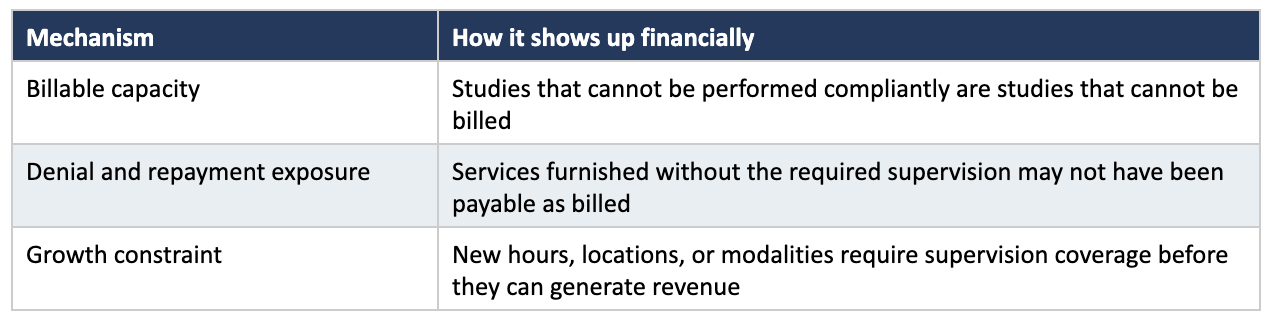
The first and third mechanisms are the ones most often missed, because neither produces an invoice, a denial letter, or any other artifact that lands on someone’s desk.
The Cost That Never Appears on a Report
When supervision coverage is unavailable, most facilities do the responsible thing: they do not perform the study. Contrast imaging gets restricted to days a physician is on site, patients get scheduled further out, or they get referred elsewhere entirely.
That is the correct decision, and it is also invisible. A denied claim generates a record. A study never performed generates nothing. There is no line item for the contrast CT a facility declined to schedule because no one was available to supervise it — which means the single largest financial effect of a supervision constraint is typically the one nobody is tracking.
This is why supervision constraints tend to persist. The compliance risk is visible and gets managed; the foregone volume is not, so it gets absorbed.
The Fixed-Cost Trap
The alternative many facilities choose is to keep a physician on site specifically to satisfy the supervision requirement. This resolves the constraint, but it converts a coverage need into a fixed cost that has to be carried during every operating hour — including hours when contrast volume does not justify it.
The economics are least favorable exactly where the access problem is worst: smaller sites, satellite locations, evenings and weekends, and any setting where contrast volume is real but not dense enough to support a dedicated physician presence. Those are the situations in which facilities are effectively choosing between an underused fixed cost and foregone volume.
Why It Gets Mis-Filed
The organizational explanation is straightforward. Compliance owns supervision because supervision is a regulatory requirement. Finance owns capacity and revenue. Neither function naturally owns the connection between them, so the connection goes unexamined — and the question “how much contrast volume are we not doing because of supervision coverage?” is one nobody is specifically accountable for asking.
How to Size It With Your Own Numbers
This is not a question that can be answered with an industry benchmark, because it depends entirely on your volume, your schedule, and your footprint. It can be answered with data you already have:
- Restricted hours: How many operating hours per week could you offer contrast-enhanced studies but currently do not, because supervision coverage is unavailable?
- Deferred or redirected studies: How many contrast studies per month are scheduled further out, declined, or sent elsewhere for coverage reasons?
- Site-level gaps: Which locations cannot offer contrast imaging at all, and what would the volume be if they could?
- Current cost of coverage: What are you spending on physician presence that exists primarily to satisfy supervision?
- Utilization of that cost: During how many of those covered hours is contrast volume actually occurring?
Those five figures produce a facility-specific picture of what supervision is costing in both directions — the volume not captured and the coverage cost not fully utilized. Most organizations find the exercise itself more revealing than the final number, because it surfaces constraints that had been treated as fixed facts of operating.
Reframing the Question
The useful shift is to treat supervision coverage planning and capacity planning as the same exercise rather than two separate ones. A coverage model that reliably meets the applicable standard protects compliance and preserves billable capacity simultaneously. A model with gaps creates exposure on both sides at once: regulatory risk where studies proceed without adequate supervision, and foregone revenue where they do not proceed at all.
Framed that way, supervision stops being purely a cost of compliance and becomes a determinant of how much imaging a facility can deliver.
How ContrastConnect Fits
ContrastConnect provides remote physician supervision of contrast administration, which addresses both sides of this equation directly: it supplies the coverage needed to meet the supervision standard, without requiring on-site physician presence during every operating hour. For facilities whose contrast capacity is limited by coverage rather than by demand, equipment, or staffing, that is where the constraint actually sits.
For determinations about payment, compliance requirements, and financial planning specific to your organization, work with your billing, compliance, and finance teams.
Trusted Nationwide































.avif)




1,000,000
Contrast exams supervised annually
75,000+
Hours of supervision monthly
4,100+
Technologists certified
500+
Imaging partners nationwide
130+
Contrast reactions treated monthly
100%
Requested hours covered
Connect with us.

