Remote Contrast Coverage vs Locum Radiologist Coverage: Cost Variability & Compliance Requirements
Key Takeaways
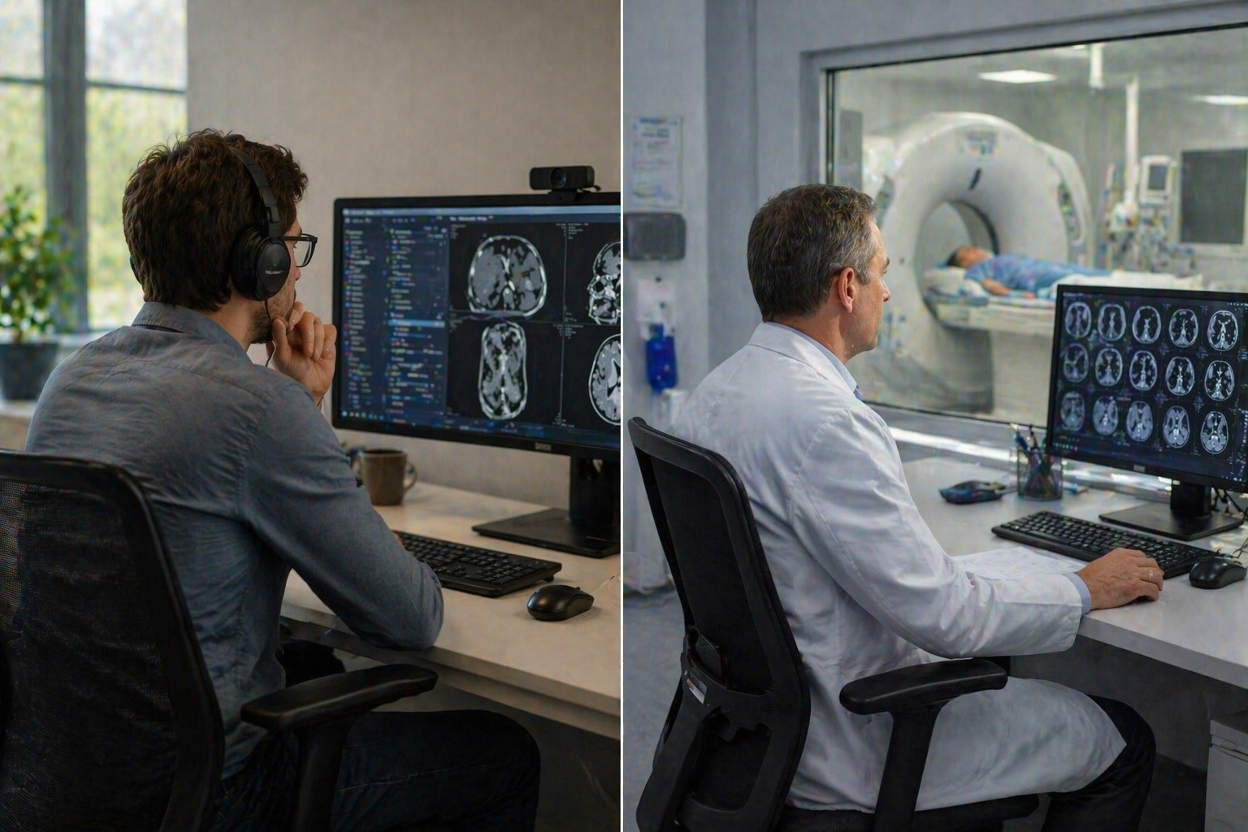
- Remote contrast coverage uses virtual supervision, where radiologists oversee contrast procedures through a secure, HIPAA-compliant platform, while locum radiologist coverage involves temporary on-site physicians who provide direct, in-person supervision, typically used for short-term staffing gaps.
- Cost variability differs significantly between the two models. Remote coverage generally offers lower overhead through hourly, daily, or monthly pricing structures and eliminates travel, lodging, and placement fees.
- Locum coverage often carries higher daily rates, credentialing costs, agency fees, and travel-related expenses that can add up quickly across extended engagements.
- Both models must meet the same CMS direct supervision requirements, but compliance considerations vary. Remote coverage relies on audit-ready digital documentation, response time guarantees, and platform reliability, while locum coverage depends on proper credentialing and in-person availability.
- ContrastConnect delivers CMS-compliant virtual contrast supervision built specifically for outpatient imaging centers and hospital networks, offering radiologist-owned clinical expertise and audit-ready documentation, helping facilities reduce cancellations, extend hours, and scale operations cost-efficiently without the overhead of locum staffing.
Remote Contrast Coverage vs Locum Radiologist Coverage: What You Need to Know First
Remote contrast coverage involves radiologists supervising contrast procedures virtually through a secure, HIPAA-compliant platform. Locum radiologist coverage, on the other hand, brings a temporary physician into your facility to provide direct in-person supervision.
While both models can meet CMS direct supervision standards, they differ in cost structure, flexibility, scalability, and compliance considerations. Remote coverage typically offers lower overhead, broader availability, and faster response times across multiple sites, while locum coverage can carry higher daily rates, credentialing delays, and travel-related expenses.
Both models can work. But they work very differently depending on your facility's size, location, patient volume, and the specific coverage gaps you're trying to fill. Understanding the structural differences before you commit to either path will save you significant time, money, and regulatory headaches.
ContrastConnect: Virtual Contrast Supervision That Never Misses
Built by Radiologists | 75,000+ Monthly Contrast Exams | Trusted Nationwide

Built for Imaging Networks:
- Virtual Contrast Supervision: Radiologists provide immediate CMS-compliant supervision through a secure, HIPAA-compliant platform for outpatient facilities and hospital networks.
- Unmatched Experience: 130+ contrast reactions treated monthly with 3,700+ technologists certified.
The ContrastConnect Difference:
- ✓ Radiologist-owned with superior clinical expertise
- ✓ Always-on platform with guaranteed compliance
- ✓ Audit-ready documentation for CMS reviews
- ✓ Cost-efficient alternative to onsite staffing
Safety & Compliance You Trust:
Helping imaging centers reduce cancellations, extend hours, and scale operations without adding on-site radiologists. Response times measured in seconds.
How Remote Contrast Coverage Works
Remote contrast coverage allows on-site radiology technologists to administer contrast agents while a qualified radiologist supervises the procedure in real time through a secure, HIPAA and HITECH-compliant two-way audiovisual platform.
The radiologist is immediately available, which is the specific distinction CMS requires for direct supervision compliance. This is an active, real-time oversight that mirrors what an on-site radiologist provides, delivered through an encrypted telecommunications infrastructure.
The technology used for remote contrast supervision must support real-time, bidirectional audio and video. The platform must be encrypted, HIPAA-compliant, and maintain a stable connection throughout the contrast procedure.
A remote supervision arrangement is only as strong as the connection supporting it. Reputable providers like ContrastConnect build redundancy into their systems to address connection failures during active contrast administration.

How Locum Radiologist Coverage Works
Locum tenens radiology involves contracting temporary, traveling radiologists to fill coverage gaps at a facility on a short-term or ongoing basis. Traditional locum arrangements require the radiologist to be physically present at the facility throughout their shift.
Hybrid arrangements have also emerged recently, in which a locum radiologist reads images remotely but does not provide the real-time contrast supervision that a dedicated remote coverage platform delivers.
Some health systems operating several outpatient imaging centers within a region have moved toward hybrid models that incorporate both on-site and remote radiologist coverage. This allows the same number of radiologists to supervise contrast administration across multiple sites simultaneously, improving efficiency without eliminating the on-site presence.
Comparing the Cost Variability Between the Two Coverage Models
Remote Contrast Coverage
Remote contrast coverage pricing is typically structured around predictable subscription or usage-based tiers (hourly, daily, monthly, or annual plans), making budgeting straightforward compared to the variable-cost environment of locum staffing.
- Fixed vs Variable Cost Structures: Rather than paying per-shift or per-day rates that fluctuate with market demand and specialty availability, facilities contract for supervision capacity at defined price points, such as hourly blocks, monthly retainers, or annual agreements.
- After-Hours & Weekend Pricing Differences: After-hours and weekend coverage is where remote contrast supervision delivers its most dramatic cost advantage. Locum radiologists command premium rates for evenings, weekends, and holidays. Remote supervision platforms price their after-hours availability far more competitively, and many structured plans include extended-hours coverage without additional surcharges.
- Revenue Gains From Extended Appointment Availability: Remote supervision enables facilities to extend contrast study appointment availability into time slots that were previously unviable without the overhead of a full on-site radiologist.
Locum Radiologist Coverage
Facilities that rely heavily on locum coverage for contrast supervision find that the true per-exam supervision cost, when fully loaded with all associated expenses, can be substantially higher than it appears in initial agency quotes.
- Daily & Hourly Rate Fluctuations: Locum radiology rates move with supply and demand dynamics in the temporary physician market. A facility that establishes a locum relationship at one rate point should not assume that rate will hold at contract renewal, particularly in a market where radiology staffing shortages continue to tighten the available pool of qualified temporary physicians.
- Hidden Costs: Malpractice, Tail Coverage, & Credentialing: Malpractice insurance for locum radiologists is an area where facilities frequently encounter costs they did not fully anticipate at the outset of a locum arrangement. While some staffing agencies include malpractice coverage in their fee structure, tail coverage is often a separate expense.
- Staffing Agency Fees & Back-Office Overhead: Staffing agencies typically charge a markup of 30–50% above the radiologist's base compensation, which is embedded in the facility's daily or hourly rate. Beyond agency fees, the facility's own administrative burden for managing locum relationships can be significant.
Compliance Requirements Side by Side
A compliance failure results in claim denials, repayment demands, and potential exclusion from federal healthcare programs. Both remote contrast coverage and locum radiologist arrangements carry specific compliance requirements, and neither model is automatically compliant simply by virtue of its structure.
Requirements For Remote Contrast Supervision
For remote contrast supervision, the compliance framework centers on CMS's revised direct supervision definition, the technical standards of the audiovisual platform, and the licensure of the supervising radiologist in the state where the procedure is performed.
All three elements must be simultaneously satisfied for every contrast study supervised remotely. A platform that is technically capable but used by a radiologist who is not licensed in the procedure constitutes a compliance failure, regardless of the platform's quality.
Requirements For Locum Radiologist Coverage
For locum radiologist coverage, compliance requirements focus on facility credentialing, state licensure, state-specific ordering and prescriptive authority requirements for contrast agents, and malpractice coverage continuity.
Facilities that rotate through multiple locum physicians must maintain active credentialing files for each physician, a process that medical staff offices frequently cite as one of their highest-volume administrative burdens.
Documentation & Audit Readiness for Each Model
Remote Contrast Coverage
For remote contrast supervision, audit readiness is largely a platform function. Purpose-built systems like ContrastConnect generate timestamped session records automatically, capturing supervising radiologist identity, licensure confirmation, supervision duration, and clinical event notes in a format that satisfies CMS documentation requirements without manual effort from facility staff.
Locum Radiologist Coverage
For locum coverage, audit readiness is a manual process that depends on the facility's medical staff office maintaining current credentialing files, malpractice verification records, and shift logs for every physician who provided coverage during the audit period. The administrative burden is real, and the failure points are numerous.

Remote Coverage vs Locum Radiologist Coverage: Comparison Table
Why Choosing ContrastConnect for Remote Coverage Is the Smarter Long-Term Investment

When comparing remote contrast coverage and locum radiologist coverage, the numbers favor remote contrast supervision across almost every cost and compliance dimension. However, the quality of the platform executing that supervision also determines whether those advantages actually materialize in practice.
ContrastConnect is radiologist-owned, which means the clinical judgment built into our protocols reflects genuine radiology expertise rather than a technology company's interpretation of what radiologists need. With over 75,000 hours of contrast exams supervised monthly, our platform eliminates the credentialing delays, geographic premiums, and after-hours cost spikes that make locum-dependent models so difficult to sustain at scale.
Start your coverage assessment now.
Frequently Asked Questions (FAQs)
Does remote contrast supervision meet CMS direct supervision requirements?
Yes. Remote contrast supervision meets CMS direct supervision requirements when conducted via a real-time, two-way, audio- and visual-interactive telecommunications platform. CMS permanently revised its direct supervision definition to allow this model, meaning the supervising radiologist must be immediately available to intervene.
How quickly can a facility switch from locum to remote contrast coverage?
Most facilities can operationalize remote contrast supervision within days to a few weeks, depending on the platform's onboarding process and the facility's internal readiness. Unlike locum arrangements, remote supervision platforms use radiologists who are already qualified.
What happens during a contrast reaction under remote supervision?
When a contrast reaction occurs under remote supervision, the on-site radiology technologist initiates the facility's emergency response protocol while the remote radiologist provides real-time clinical direction through the audiovisual connection. The radiologist assesses the severity of the reaction and coordinates with on-site nursing or emergency response staff as needed.
Can remote contrast coverage scale with growing patient volume?
Yes, remote contrast supervision scales in ways that locum staffing structurally cannot. A single remote radiologist can simultaneously supervise contrast administration across multiple facility locations. This means that as a health system adds imaging sites or increases volume at existing sites, supervision capacity expands without a proportional increase in radiologist headcount or cost.
How does ContrastConnect ensure safety during remote coverage?
At ContrastConnect, our supervision protocols are designed by physicians who understand contrast administration risk from direct clinical experience. Our platform's technical infrastructure is built with redundancy specifically to prevent connection failures during active contrast supervision.
HIPAA and HITECH-compliant encryption protects the integrity of the audiovisual connection, and the platform's architecture is designed to maintain stable performance across varied facility internet environments.
*Note: Information provided is for general guidance only and does not constitute medical, legal, or financial advice. Pricing estimates and regulatory requirements are current at the time of writing and subject to change. For personalized consultation on imaging center operations and virtual contrast supervision, contact ContrastConnect.
Trusted Nationwide
















.avif)




1,000,000
Contrast exams supervised annually
75,000+
Hours of supervision monthly
3,900+
Technologists certified
100s
Of imaging partners nationwide
130+
Contrast reactions treated monthly
100%
Requested hours covered
Connect with us.

