Peer Review and Quality Assurance for Contrast Supervision Programs
Supervision has an unusual quality-assurance problem: when it is working, nothing happens. There is no output to inspect, no report to review, no image to compare against a prior. A department can go months believing its supervision arrangement is sound and only discover otherwise during a survey, a claim review, or — worst case — during a reaction.
That is why supervision programs benefit from deliberate internal review. This article covers what to examine, how often, who should own it, and what to do with what you find.
This article is general operational guidance. It is not legal, compliance, or clinical advice. Peer review protections and requirements vary by state and organization — confirm how your review activities should be structured with your compliance team and legal counsel.
Why Supervision Needs Its Own Review
Most imaging quality programs review things that leave evidence — image quality, report turnaround, protocol adherence, dose. Supervision leaves evidence only if someone deliberately created it, which means a supervision gap and a documentation gap look identical from the outside.
The distinction matters because the remedies are different. If supervision genuinely was not available, that is a coverage problem. If it was available but not recorded, that is a workflow problem. You cannot tell which you have without looking, and you cannot fix either one you have not identified.
What to Review
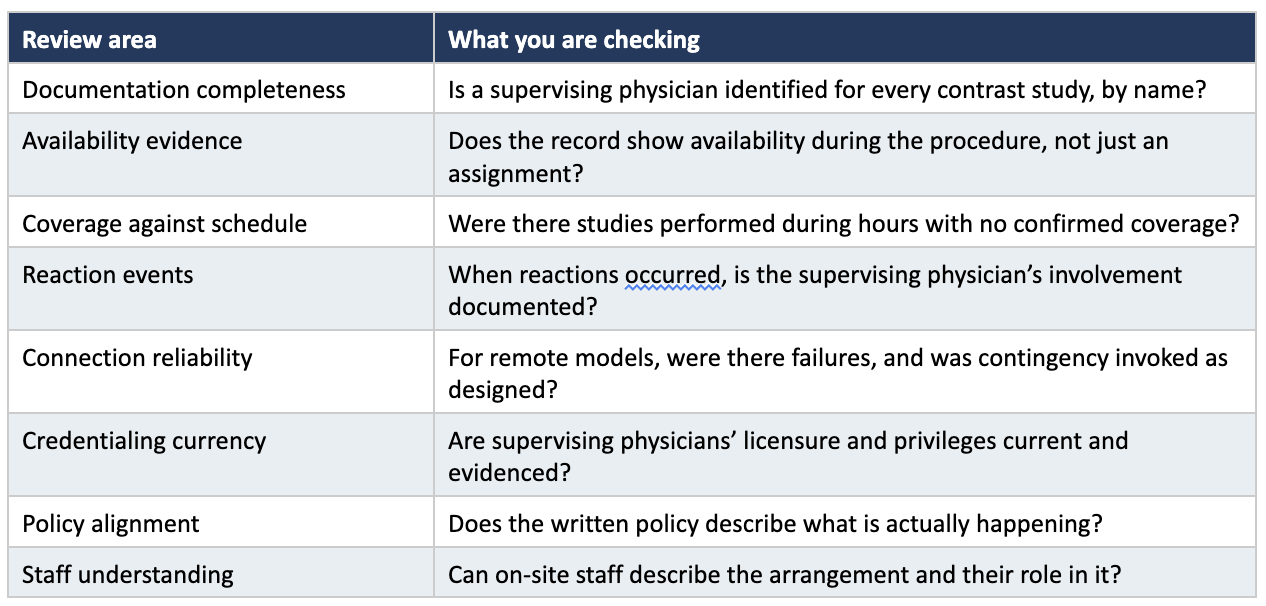
The third row is the one that finds real problems. Comparing studies performed against confirmed coverage windows will surface any hours where imaging proceeded without supervision in place — which is precisely the finding you want to make internally rather than have made for you.
Peer Review vs. Quality Assurance
These terms get used loosely and are worth separating. Quality assurance is the operational discipline of checking that a process is working — sampling records, verifying completeness, tracking trends. Peer review generally refers to structured evaluation of clinical performance by professional peers, and in many jurisdictions carries specific legal protections and procedural requirements.
Most supervision review is QA rather than peer review: you are checking whether the process ran, not evaluating a physician’s clinical judgment. Where a review does extend into clinical performance — for example, examining how a reaction was managed — it may belong in a peer review structure instead. How to structure that, and what protections apply, is a question for your compliance team and counsel rather than something to decide informally.
How to Sample
Reviewing every study is unnecessary and usually unsustainable. A workable approach:
- Take a periodic random sample across sites, shifts, and modalities — the point is representativeness, not volume.
- Deliberately oversample the edges. Evenings, weekends, holidays, and satellite locations are where gaps concentrate, and a purely random sample will under-represent them.
- Review all reaction events, without sampling. These are low-frequency and high-consequence.
- Check after changes. A new location, new hours, a new provider, or a rule change all warrant a review rather than waiting for the next cycle.
Cadence and Ownership
Two failure modes are common. The first is no defined owner — supervision QA falls between compliance, radiology operations, and the supervision vendor, and consequently nobody does it. The second is an annual review only, which means a problem introduced in month two runs for ten months before anyone notices.
A named owner and a regular cadence solve both. The specific frequency matters less than that it is defined, happens, and produces something someone reads.
What to Do With Findings
- Distinguish coverage gaps from documentation gaps — they have different fixes.
- Look for patterns rather than incidents. One missing record is an error; the same location missing records every Saturday is a structural problem.
- Fix the workflow, not the instance. Correcting a record without correcting what produced the gap guarantees a repeat.
- Document the review itself. A record showing you review supervision periodically and act on findings is meaningful evidence of a functioning program.
That last point is often underrated. Demonstrating an active QA process is a materially different position from asserting that supervision has always been fine.
Reviewing a Vendor-Supplied Program
Where supervision is provided by an external partner, review does not transfer to them. The facility remains accountable for whether supervision occurred and can be evidenced, which means confirming rather than assuming what the provider captures.
Worth establishing explicitly:
- What records does the provider maintain, and what can you access on demand?
- Can you obtain records for a specific study on request, quickly?
- Who notifies whom about credentialing expirations or coverage gaps?
- Would you retain access to historical records if the relationship ended?
How ContrastConnect Supports Review
ContrastConnect provides remote physician supervision of contrast administration with the supervising physician identified per study and records evidencing availability — which is what makes internal review possible rather than theoretical. Reviewing the program remains the facility’s responsibility; a provider’s job is to make sure there is something to review and that you can get to it when you ask.
Trusted Nationwide


















.avif)




1,000,000
Contrast exams supervised annually
75,000+
Hours of supervision monthly
4,100+
Technologists certified
500+
Imaging partners nationwide
130+
Contrast reactions treated monthly
100%
Requested hours covered
Connect with us.

