How Supervision Level Affects Billing Eligibility for Contrast Studies


Most imaging leaders think of physician supervision as a clinical and regulatory obligation. It is both—but it is also something else that gets less attention: a condition of payment. When a contrast-enhanced study is performed without the required level of supervision, the issue is not only a compliance gap. The service may not be payable at all. This article explains the structural relationship between supervision level and billing eligibility, and why that connection matters operationally.
This article is general information about how supervision requirements relate to payment. It is not billing, coding, or legal advice. Coding decisions and claims determinations should be made by your own billing, coding, and compliance professionals based on current rules and your specific circumstances.
Supervision as a Condition of Payment
For many services, the applicable supervision requirement is not an optional best practice layered on top of the procedure—it is part of what defines the service as having been properly furnished. If the required supervision was not provided, the service as billed was not, strictly speaking, the service that was delivered.
That distinction is what turns supervision into a revenue question. A facility can perform a technically excellent study, document the clinical findings thoroughly, and still have a payment problem if the supervision standard applicable to that procedure was not met while it was performed.
A Quick Refresher on the Levels
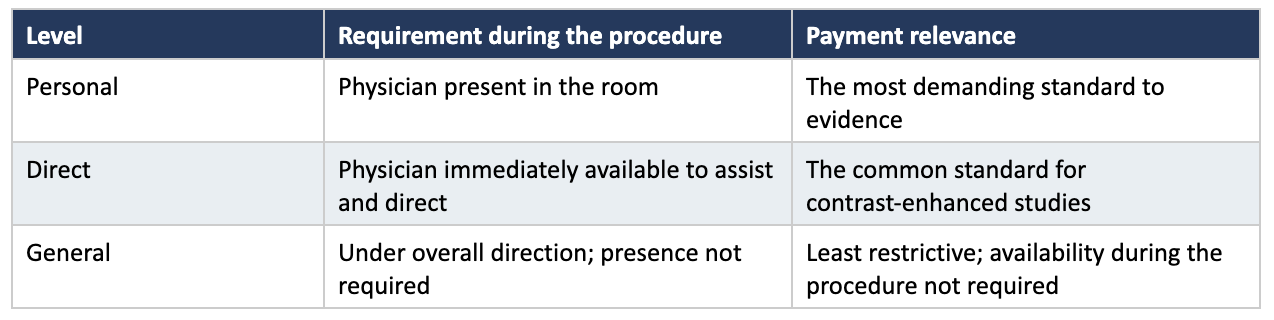
Three levels of physician supervision are generally recognized, and which one applies determines what had to be true during the procedure:
Contrast-enhanced imaging typically sits at the direct supervision tier, which is why coverage planning and payment eligibility are so tightly linked for these studies specifically.
What Happens When the Standard Isn’t Met
The consequences of a supervision gap are not limited to a single denied claim. Depending on the circumstances, a facility may face:
- Services that were not billable as furnished, because a condition of payment was not satisfied.
- Denials or claim adjustments if the gap is identified during review.
- Repayment exposure if services already paid are later determined not to have met requirements.
- Pattern risk, where a recurring coverage gap affects a volume of studies rather than an isolated case.
The last point is the one that tends to surprise people. Supervision gaps are rarely one-off events—they usually stem from a structural coverage problem, such as a location or shift routinely operating without the required availability. That means the exposure scales with volume.
Why Contrast Studies Concentrate the Risk
Contrast-enhanced CT and MRI are among the highest-value studies an outpatient facility performs, and they are also the studies most dependent on supervision availability. That combination concentrates financial exposure in a specific place: the studies that contribute most to revenue are the same ones that become unbillable first when supervision coverage lapses.
It also explains a pattern many centers recognize. Rather than risk performing contrast studies without adequate supervision, facilities restrict them to days when a physician is on site—protecting compliance at the cost of capacity, access, and revenue. The constraint is real either way; the only question is whether it shows up as compliance risk or as foregone volume.

Where the Determination Actually Gets Made
Several layers interact to determine what applies to a given study, which is why this cannot be reduced to a single rule:
- The procedure itself, which carries an assigned supervision requirement.
- The setting, since requirements can differ between hospital outpatient departments and freestanding facilities.
- Federal rules, which establish the baseline supervision standards and how they may be met.
- State law, including scope-of-practice rules governing who may supervise and whether remote supervision is permitted.
- Payer policy, which may impose its own documentation or coverage expectations.
Because these layers change independently and the most restrictive generally governs, the applicable standard should be confirmed for each procedure, setting, and jurisdiction rather than assumed from a single national rule.
The Operational Takeaway
The practical implication is straightforward: supervision coverage planning and revenue planning are the same exercise. A coverage model that reliably meets the applicable standard protects both compliance and billable capacity. A model with gaps creates exposure on both fronts simultaneously—which is why supervision belongs in operational and financial planning conversations, not only compliance ones.
This is also why documentation matters so much. Meeting the standard and being able to demonstrate that it was met are different things, and only the second one survives a review.
How ContrastConnect Fits
ContrastConnect provides remote physician supervision of contrast administration, designed around the elements that make the standard defensible: qualified and appropriately licensed physicians, real-time availability throughout the procedure, secure connectivity, and documentation that evidences the supervision provided. For facilities whose contrast capacity is limited by supervision coverage, closing that gap addresses the compliance requirement and the billable-capacity constraint at the same time.
For questions about how any of this applies to specific claims, codes, or payer policies, work with your billing, coding, and compliance teams—those determinations are properly theirs.
Trusted Nationwide































.avif)




1,000,000
Contrast exams supervised annually
75,000+
Hours of supervision monthly
4,100+
Technologists certified
500+
Imaging partners nationwide
130+
Contrast reactions treated monthly
100%
Requested hours covered
Connect with us.

