AI in Contrast-Enhanced Mammography: Detection, Workflow & 2026 Clinical Use Cases

Key Takeaways
- Contrast-enhanced mammography (CEM) can produce false positives due to background parenchymal enhancement, and as contrast procedures increase across multiple sites, ensuring adequate physician supervision becomes more challenging.
- AI detection tools reduce unnecessary callbacks by analyzing enhancement morphology, intensity, and spatial distribution to separate benign uptake from biopsy-worthy findings.
- Three high-impact 2026 CEM use cases are dense breast supplemental screening, neoadjuvant chemotherapy response monitoring, and pre-surgical tumor mapping.
- Every CEM exam requires Centers for Medicare and Medicaid Services (CMS) direct physician supervision during contrast administration, creating a staffing bottleneck for multi-site networks.
- ContrastConnect provides virtual contrast supervision with specialized radiologists, CMS-compliant documentation, and response times in seconds to help facilities scale CEM programs.
Why AI Is Gaining Ground in Contrast-Enhanced Mammography
AI is reshaping contrast-enhanced mammography on three fronts: detection accuracy, workflow speed, and how facilities use CEM in everyday clinical practice. Deep learning models trained on CEM datasets can flag suspicious enhancement patterns on subtracted images, helping standardize read quality across multi-site networks where interpreter expertise varies.
The operational side matters just as much. Automated subtraction processing, AI-powered triage, and structured reporting tools let facilities absorb rising CEM volumes without extending turnaround times. With all major mammography manufacturers now offering dual-energy systems compatible with AI software, outpatient networks have a more accessible entry point to enhanced breast imaging than in previous years.
Pairing those tools with reliable contrast supervision is the remaining bottleneck. ContrastConnect gives imaging centers qualified radiologist coverage through a virtual platform so facilities can expand CEM without adding on-site staffing at every location.
ContrastConnect: Virtual Contrast Supervision That Never Misses
Built by Radiologists | 75,000+ Hours Monthly Contrast Exams | Trusted Nationwide

Built for Imaging Networks:
- Virtual Contrast Supervision: Radiologists provide immediate CMS-compliant supervision through a secure, HIPAA-compliant platform for outpatient facilities and hospital networks.
- Unmatched Experience: 130+ contrast reactions treated monthly with 3,900+ technologists certified.
The ContrastConnect Difference:
- ✓ Radiologist-owned with superior clinical expertise
- ✓ Always-on platform with guaranteed compliance
- ✓ Audit-ready documentation for CMS reviews
- ✓ Cost-efficient alternative to onsite staffing
Safety & Compliance You Trust:
Helping imaging centers reduce cancellations, extend hours, and scale operations without adding on-site radiologists. Response times measured in seconds.
What Is Contrast-Enhanced Mammography?
CEM is a dual-energy mammographic technique that uses an intravenous iodinated contrast agent to highlight areas of neoangiogenesis in breast tissue. After contrast injection, the system captures both low-energy and high-energy images, then generates subtracted images that isolate areas of contrast uptake. The result is a mammogram that shows both structural detail and functional vascular information.
CEM has gained attention as a more accessible and lower-cost alternative to breast MRI for patients who need enhanced imaging. It is particularly useful for women with dense breast tissue, where standard mammography may miss clinically significant lesions. As more facilities add CEM to their service lines, the volume of contrast procedures requiring qualified physician supervision is increasing steadily.
How AI Improves Detection in CEM
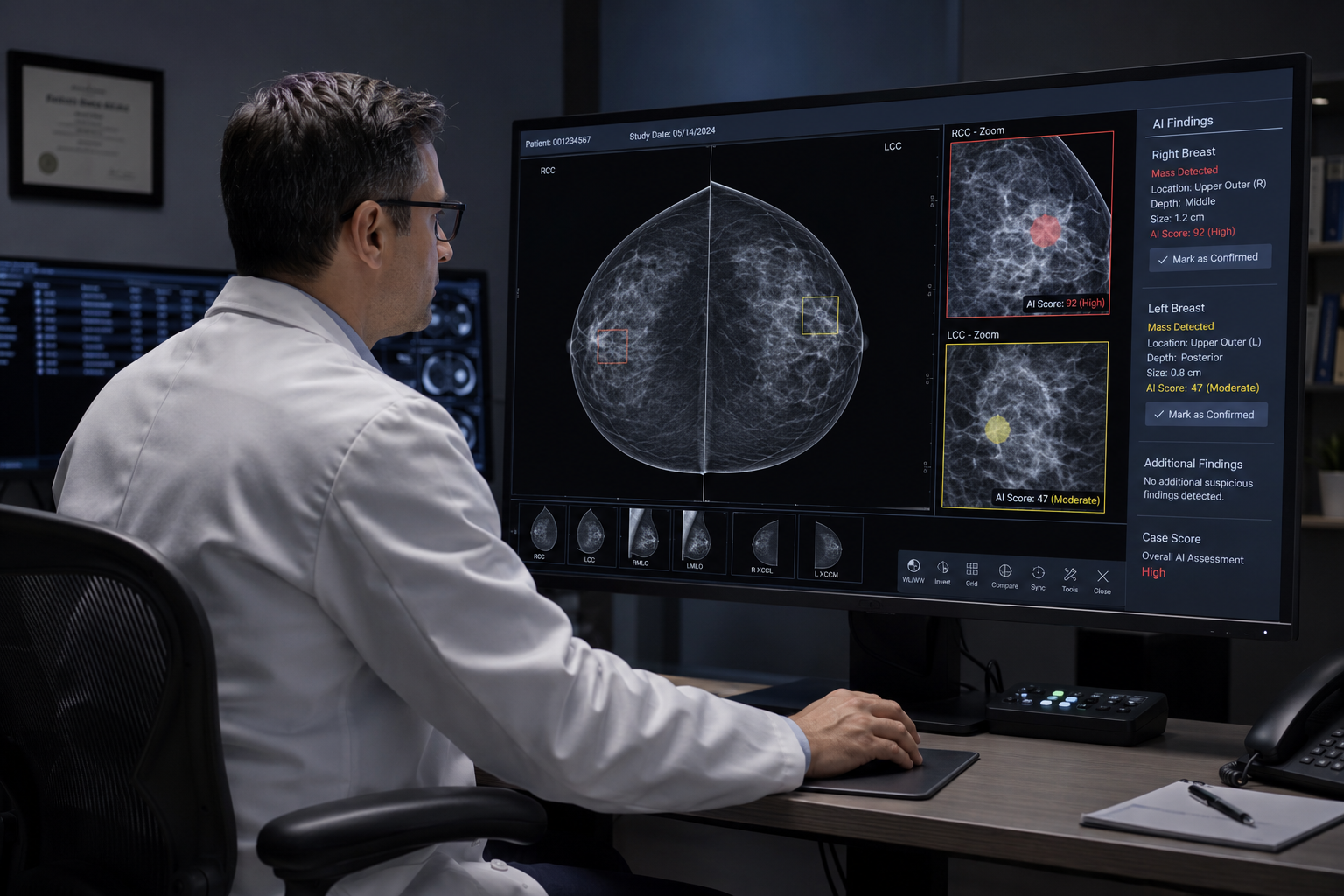
AI tools designed for CEM focus primarily on analyzing subtracted images to identify and classify enhancing lesions. Deep learning models trained on large datasets of CEM studies can flag regions of suspicious enhancement that a radiologist might otherwise overlook, particularly in complex backgrounds with heterogeneous enhancement patterns.
One of the most significant contributions of AI in CEM is reducing false-positive rates. Standard CEM interpretation can produce background parenchymal enhancement that mimics malignancy. AI algorithms help distinguish between benign enhancement and findings that warrant biopsy by analyzing enhancement morphology, intensity, and spatial distribution. This reduces unnecessary callbacks and invasive procedures.
AI also supports less experienced readers by providing a second-look tool that improves consistency across interpreting physicians. For multi-site imaging networks where reader expertise varies, AI-driven detection tools help standardize the quality of CEM reads without requiring every location to staff a specialist breast imager.
AI-Driven Workflow Optimization for CEM
AI streamlines several workflow bottlenecks associated with CEM. Automated image processing tools can handle subtraction image generation, quality checks, and preliminary lesion annotation before the radiologist opens the study. This pre-processing reduces read times and allows facilities to maintain throughput even as CEM volumes increase.
AI-powered triage systems that prioritize studies based on the probability of significant findings are being developed for breast imaging and could help ensure that high-suspicion CEM cases reach the interpreting radiologist faster. For facilities managing large daily volumes of contrast-enhanced studies, this kind of intelligent routing prevents delays in diagnosis.
Reporting is another area where AI adds value. Emerging natural language processing tools show potential for assisting with structured radiology reporting, which could eventually help radiologists draft and finalize CEM reports more efficiently. This reduces administrative time and ensures that reports include standardized descriptors aligned with BI-RADS conventions.
2026 Clinical Use Cases for AI in CEM
Supplemental Screening for Dense Breast Tissue
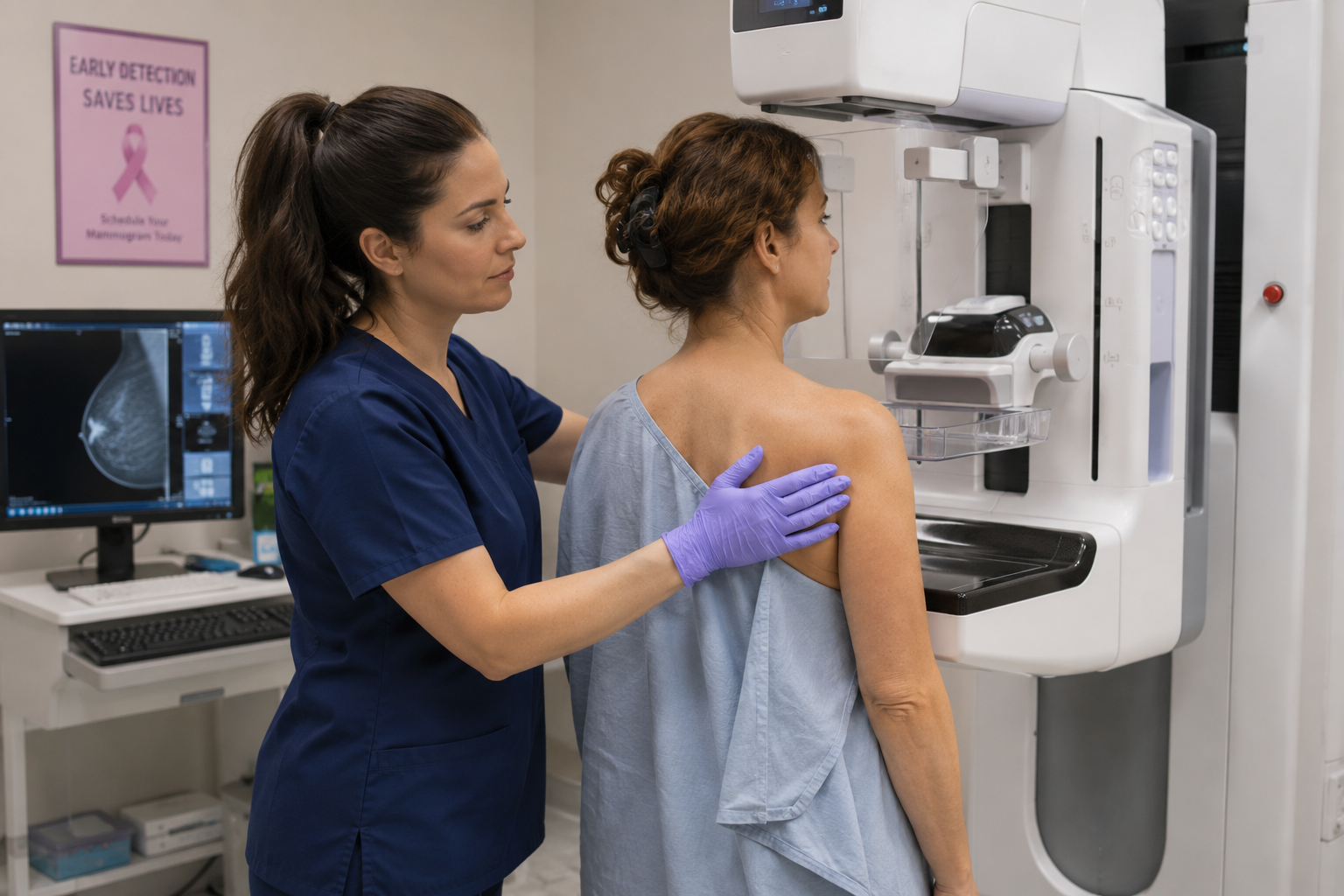
With federal dense breast notification requirements now in effect, demand for supplemental screening modalities has surged. CEM provides a practical option for facilities that lack MRI capacity or serve patients who cannot undergo MRI. AI-enhanced CEM improves the sensitivity of supplemental screening by catching small enhancing lesions that dense tissue can obscure on standard views.
Neoadjuvant Chemotherapy Response Monitoring
Oncology teams increasingly rely on imaging to assess tumor response during neoadjuvant chemotherapy. AI-powered CEM can track changes in enhancement patterns between treatment cycles, providing quantitative measurements of tumor shrinkage or progression. This gives oncologists actionable data without the scheduling constraints and higher costs associated with repeated MRI studies.
Pre-Surgical Tumor Mapping
Accurate tumor extent mapping before surgery improves surgical planning and reduces re-excision rates. AI algorithms applied to CEM can delineate tumor margins and identify satellite lesions, giving surgeons a clearer picture of disease extent. As more breast centers adopt CEM for surgical planning, AI tools are expected to become standard components of the pre-operative imaging workup.
Supervision Requirements for Contrast-Enhanced Procedures
Every CEM exam involves administering an iodinated contrast agent, which carries a risk of adverse reactions ranging from mild allergic responses to severe anaphylaxis. CMS requires that a qualified physician provide direct supervision during contrast administration in outpatient settings. For imaging networks operating across multiple sites, maintaining consistent on-site physician coverage for every contrast exam is a significant staffing and cost challenge.
Virtual contrast supervision is a practical solution, allowing qualified radiologists to provide immediate, real-time oversight through secure, HIPAA-compliant platforms. This model meets CMS requirements for direct supervision while eliminating the need for a physician to be physically present at each location. As AI-enhanced CEM expands into more facilities, pairing advanced detection tools with reliable virtual supervision ensures that both diagnostic quality and patient safety standards are maintained.
Scaling AI-Enhanced CEM With ContrastConnect
As AI tools for contrast-enhanced mammography mature, imaging networks that adopt them early stand to gain meaningful advantages in detection consistency, operational throughput, and clinical versatility. For networks scaling CEM across multiple locations, we at ContrastConnect provide the supervision infrastructure that makes safe, high-volume contrast imaging sustainable and compliant.
We pair specialized radiologist oversight with scalable, always-on coverage so your team can focus on integrating AI into clinical reads rather than managing staffing logistics. Start your coverage assessment with ContrastConnect today to see how our platform fits your CEM growth plan.
Frequently Asked Questions (FAQs)
Does AI replace the radiologist in contrast-enhanced mammography?
AI serves as a decision-support tool that flags potential findings on CEM images. A qualified radiologist still reviews every study, makes the final interpretation, and manages all clinical decisions based on the complete imaging picture.
Is contrast-enhanced mammography safe for all patients?
Most patients tolerate CEM well, but iodinated contrast carries risks for individuals with severe contrast allergies or significantly impaired kidney function. A supervising physician evaluates each patient's medical history before contrast administration to minimize adverse events.
Can AI detect cancers that standard mammography misses?
AI-enhanced CEM has shown improved sensitivity for identifying cancers in dense breast tissue compared to standard mammography alone. It is currently used as a supplemental screening tool rather than a standalone replacement for conventional mammographic screening.
What equipment do facilities need to offer AI-powered CEM?
Facilities require a CEM-capable dual-energy mammography unit, contrast injection equipment, and compatible AI software integrated with their existing PACS infrastructure. Specific hardware and software requirements vary by vendor.
How does ContrastConnect support facilities providing CEM?
At ContrastConnect, we provide virtual contrast supervision through a secure platform staffed by specialized radiologists. We cover daytime, evening, weekend, and holiday shifts with response times in seconds, helping facilities scale CEM programs while maintaining full CMS compliance and audit readiness.
*Note: Information provided is for general guidance only and does not constitute medical, legal, or financial advice. Pricing estimates and regulatory requirements are current at the time of writing and subject to change. For personalized consultation on imaging center operations and virtual contrast supervision, contact ContrastConnect.
Trusted Nationwide














.avif)



1,000,000
Contrast exams supervised annually
75,000+
Hours of supervision monthly
4,100+
Technologists certified
500+
Imaging partners nationwide
130+
Contrast reactions treated monthly
100%
Requested hours covered
Connect with us.

