Administering vs. Supervising Contrast


Two questions get asked as though they are one: who can give the contrast, and who has to be supervising while they do it. They are separate requirements with separate rules, and treating them as a single question is one of the more common ways an imaging department ends up with a compliance gap it did not know it had.
This article is about the relationship between the two functions — why the distinction exists, what happens when it collapses, and how the two interact in practice.
This article is general information. It is not legal, compliance, or clinical advice. Requirements vary by federal rule, state law, and facility policy. Confirm what applies to your facility with your compliance team and legal counsel.
Two Functions, Two Rulebooks
Administering contrast is a clinical task: establishing access, operating the injector, delivering the agent. Who may perform it is governed largely by state scope-of-practice law and facility policy — which is why the answer differs between states and between departments.
Supervising is a regulatory function: a qualified individual being immediately available to direct management if the patient reacts. Who may provide it, and what “available” requires, is governed by the supervision rules attaching to the procedure itself — which do not change based on who is holding the syringe.
The two questions therefore have different answers, drawn from different sources, and satisfying one tells you nothing about whether you have satisfied the other.
Where Facilities Conflate Them
The confusion tends to take one of three forms:
- “We have qualified staff administering, so we’re covered.” Competence to administer is not the same as satisfying the supervision requirement. The skill of the person injecting does not substitute for physician availability.
- “A physician is in the building.” Presence is not availability. A physician occupied with something that cannot be interrupted is not immediately available to direct.
- “Someone is on call.” Reachable by phone from elsewhere is generally a different standard from immediately available during the procedure.
Each of these is a reasonable-sounding assumption, and each leaves the same gap: the study proceeded, the administration was performed correctly, and the supervision requirement was not actually met.
Who Does What
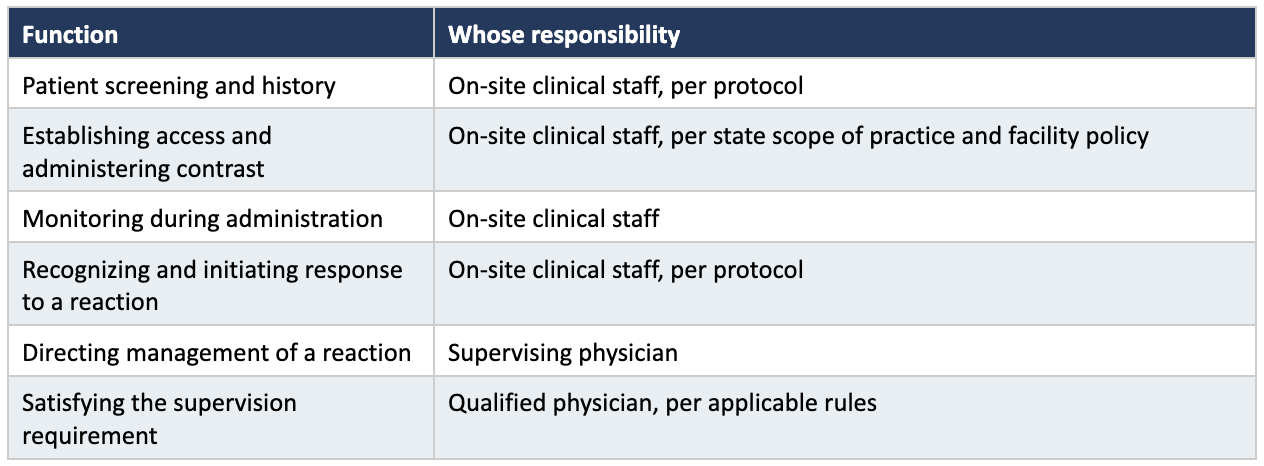
The line falls between the fourth row and the fifth. On-site staff act; the supervising physician directs. Everything above the line can be perfectly executed while everything below it is missing.
How the Two Interact During a Reaction
The distinction stops being theoretical the moment a patient reacts. On-site staff recognize it, begin the response per protocol, and communicate what they are seeing. The supervising physician directs management from there.
This is a handoff, and handoffs need both parties present. Without the supervising physician, on-site staff are left directing management themselves — which is not a responsibility that was ever assigned to them, and not one their scope of practice necessarily supports. Without competent on-site staff, a supervising physician has no way to act. Neither function is optional and neither covers for the other.
Why the Distinction Has Practical Consequences
Getting this wrong shows up in three places:
- Compliance. A study performed without the required supervision did not meet a condition attaching to the procedure, regardless of how well the administration went.
- Clinical risk. The scenario the supervision requirement exists for is precisely the one where its absence matters most.
- Staff exposure. Clinical staff who find themselves directing management of a reaction without physician support are carrying something outside what was asked of them.
The third is the one departments tend to think about least and staff think about most.
Under Virtual Supervision
Remote supervision does not change the division of functions — it changes only where the supervising physician is standing. On-site staff still administer, monitor, and initiate. The physician still directs. What remote delivery adds is that availability no longer depends on someone being in the building, which is precisely the constraint that causes most supervision gaps in the first place.
It also makes the distinction more visible, which is useful. In a virtual model, the supervising physician for each study is explicitly identified and connected, so the question “who is supervising this?” has a concrete answer rather than an assumed one.
A Quick Self-Check
- For a contrast study performed at 5pm on Friday at your busiest site, who was supervising — by name?
- Did on-site staff know who that was at the time?
- If they had needed direction within sixty seconds, could they have had it?
- Is that answer the same for every location and every operating hour?
- Could you evidence it if asked?
Departments that can answer all five comfortably have the distinction working. Departments that cannot usually have staff who are administering well and supervision that exists mainly on the org chart.
How ContrastConnect Fits
ContrastConnect supplies the supervision side specifically — a qualified physician, identified for each study, available in real time to direct management if a reaction occurs. It does not change who may administer contrast at your facility, and it does not reduce what on-site staff are responsible for. It ensures the other half of the arrangement is actually there during the hours you are performing contrast studies.
Trusted Nationwide


















.avif)




1,000,000
Contrast exams supervised annually
75,000+
Hours of supervision monthly
3,900+
Technologists certified
100s
Of imaging partners nationwide
130+
Contrast reactions treated monthly
100%
Requested hours covered
Connect with us.

