Virtual Contrast Supervision: What It Is, What It Requires, and How It Works


Virtual contrast supervision is physician supervision of contrast administration provided remotely, in real time, rather than by a physician physically present in the imaging facility. A qualified physician is connected by live audio and video and is immediately available to direct the response if a patient reacts to the contrast agent.
For imaging centers, it is the mechanism that decouples contrast-enhanced imaging from on-site physician staffing. This page explains what it is, why contrast requires supervision at all, what a compliant arrangement involves, and how it works day to day.
This article is general information about how virtual contrast supervision works. It is not legal, compliance, or clinical advice. Requirements vary by federal rule, state law, facility type, and payer — confirm what applies to your organization with your own compliance and legal professionals.
Why Contrast Administration Requires Supervision
Contrast media is safe for the overwhelming majority of patients, but a small proportion experience adverse reactions, and a small subset of those escalate quickly. Because of that possibility, contrast-enhanced studies generally require a qualified physician to be available while contrast is administered — someone able to direct management if a reaction occurs.
The requirement is therefore about availability rather than participation. The supervising physician does not administer the contrast or perform the study. They are the person who can be called upon, without delay, if something goes wrong.
What Makes It “Virtual”
The supervision standard applicable to most contrast-enhanced studies requires a physician to be immediately available to assist and direct — not to be in the room, and not to perform any part of the procedure. Once availability is understood as the operative requirement, the question becomes whether a physician connected in real time is genuinely available to direct.
Virtual contrast supervision answers that question with live, two-way audio and video plus a physician who is present and attentive for the duration of the study. The standard is unchanged; only the means of meeting it differs. This is worth stating plainly because the most common misconception about the model is that it represents a relaxed requirement. It does not.
Contrast Supervision vs. Contrast Coverage
These two terms circulate interchangeably and it is useful to separate them. Contrast supervision describes the regulatory function — the physician oversight a contrast study requires. Contrast coverage describes the operational arrangement that supplies it — which physicians cover which sites during which hours.
A facility needs supervision because a rule requires it; it buys coverage because supervision has to be staffed. Keeping the distinction straight helps when comparing providers, because coverage models differ considerably even where the supervision standard being met is identical.
Who Can Provide It
The supervising individual must be qualified to direct management of a contrast reaction, and must be appropriately licensed for the jurisdiction where the patient is located and privileged at the facility being covered. Whether non-physician practitioners may supervise depends on federal rules, state scope-of-practice law, and facility policy — three layers that do not always agree, with the most restrictive generally governing.
What a Compliant Arrangement Requires
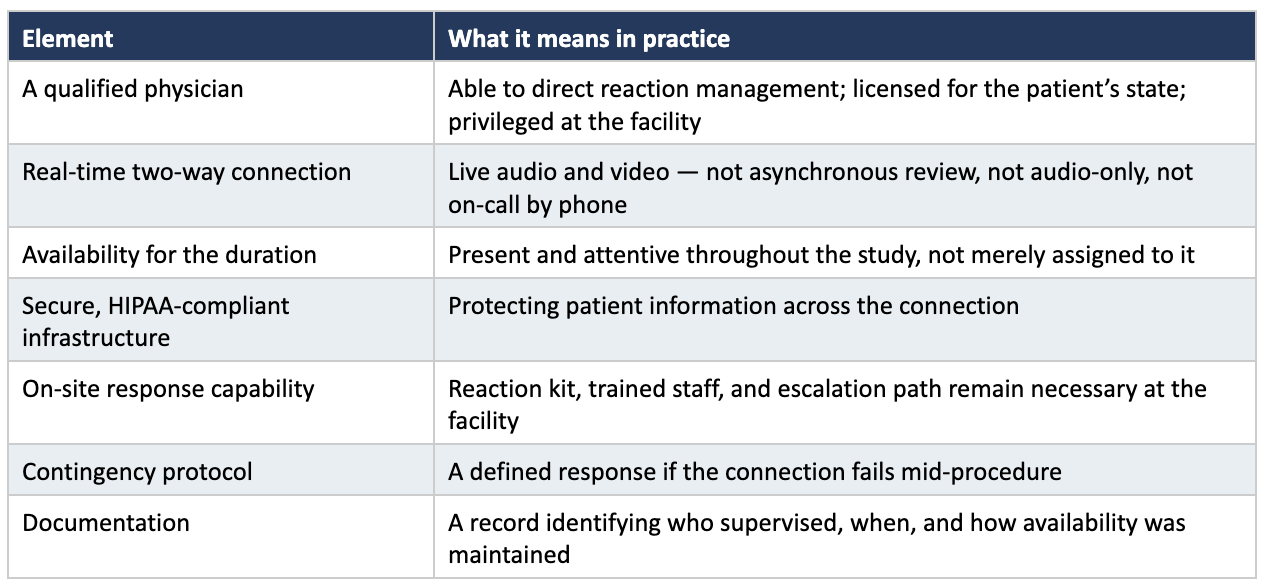
The fifth element is the one facilities most often misread. Virtual supervision supplies physician direction; it does not replace on-site readiness. The kit, the trained technologists, and the escalation path are still required.
How It Works Day to Day
- Assignment. A specific supervising physician is identified for the coverage period, so responsibility for any given study is unambiguous.
- Connection. A secure live connection links the on-site team to that physician for the procedure.
- Administration. On-site staff screen and prepare the patient and administer contrast per protocol, with the physician available throughout.
- Escalation if needed. If a reaction occurs, the physician directs management in real time while on-site staff execute.
- Documentation. The supervision provided is recorded so it can be evidenced later.
What It Enables
The operational case is straightforward. Where supervision is the constraint on contrast imaging — rather than demand, equipment, or technologist staffing — remote supervision removes it. That typically shows up in three ways:
- More hours. Contrast studies can be offered during evenings, weekends, and shoulder hours without on-site physician presence.
- More locations. Satellite and smaller sites can offer contrast imaging without each carrying its own physician coverage.
- Fewer restrictions. Facilities stop limiting contrast studies to the days a physician happens to be present.
The corollary is that where supervision is not the constraint, remote supervision will not solve the problem. Diagnosing the actual bottleneck first is worth the effort.
The Regulatory Layer
Two sets of rules apply simultaneously. Federal rules establish the baseline supervision standards and the conditions under which they may be met remotely. State law governs scope of practice and, in a growing number of states, addresses remote supervision of contrast administration directly. Federal permission does not override a stricter state requirement.
Because both layers have changed repeatedly in recent years, the applicable standard should be confirmed for each state of operation rather than assumed uniform — and reviewed periodically rather than treated as settled.
How ContrastConnect Provides It
ContrastConnect delivers virtual contrast supervision built around the elements above: appropriately licensed and credentialed physicians, a real-time connection maintained for the duration of each study, secure infrastructure, defined contingency handling, and documentation that identifies the supervising physician and evidences availability. For imaging centers whose contrast capacity is limited by coverage rather than demand, that is the constraint being removed.
Trusted Nationwide































.avif)




1,000,000
Contrast exams supervised annually
75,000+
Hours of supervision monthly
4,100+
Technologists certified
500+
Imaging partners nationwide
130+
Contrast reactions treated monthly
100%
Requested hours covered
Connect with us.

