Direct Supervision in Radiology: Requirements, Levels, and Compliance


Direct supervision is one of the most consequential terms in imaging compliance, and one of the most frequently misunderstood. It determines who must be available when a contrast-enhanced study is performed, where that person has to be, and whether a facility can bill for the service at all. This guide explains what direct supervision means, how it sits alongside the other supervision levels, what “immediate availability” actually requires, and how imaging facilities meet the standard in practice.
What Is Direct Supervision?
Direct supervision means a qualified physician must be immediately available to furnish assistance and direction throughout the performance of a procedure. Critically, it does not require the physician to be in the room while the procedure takes place—that is a stricter standard called personal supervision. What direct supervision requires is availability: someone qualified must be reachable and able to intervene without delay if something goes wrong.
For contrast-enhanced imaging, this requirement exists for a clear clinical reason. Contrast media carries a small but real risk of adverse reaction, and some reactions escalate quickly. Direct supervision ensures that a physician capable of managing a reaction is available for the duration of the study rather than being summoned from elsewhere after a problem has already developed.
The Three Levels of Physician Supervision
Direct supervision is the middle tier of a three-level framework. Understanding all three is the fastest way to understand what direct supervision does and does not demand:
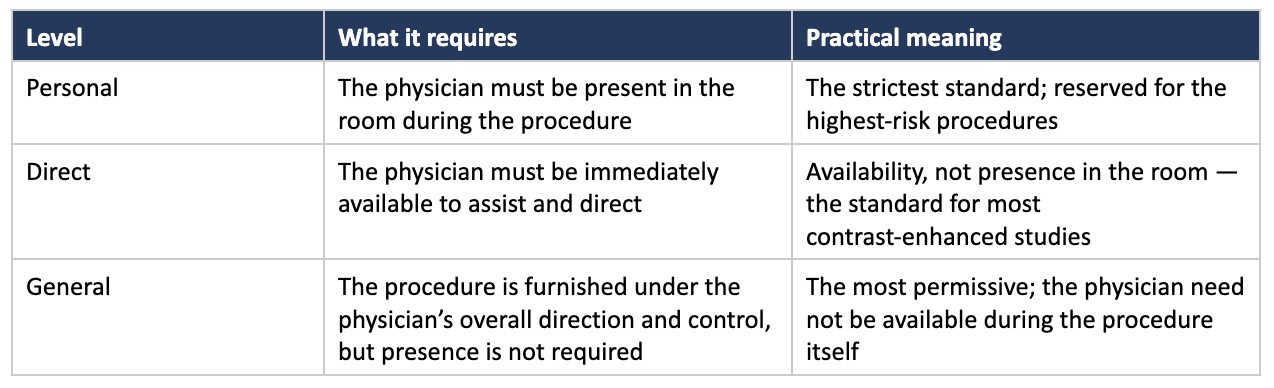
Facilities most often run into compliance problems by conflating direct supervision with either of its neighbors—assuming it requires a physician in the room (over-restrictive, and operationally expensive), or treating it as general supervision (under-restrictive, and a genuine compliance exposure).
What “Immediate Availability” Means
The phrase that carries the most weight in the definition is “immediately available,” and it is where interpretation matters most. The standard has historically been understood to mean the physician is on the premises and able to intervene without delay—not merely on call, not reachable by phone at a distance, and not occupied with another procedure that could not be interrupted.
Two points follow from this. First, physical proximity alone does not satisfy the standard if the physician is unavailable in practice. Second, and more consequentially for modern imaging, the requirement is fundamentally about availability and ability to direct—which is why remote supervision models have become viable as real-time communication technology has matured.
Who Can Provide Direct Supervision
The supervising individual must be qualified to manage the procedure and its potential complications. For contrast administration, that generally means a physician, though the specific practitioners permitted—including whether non-physician practitioners such as nurse practitioners and physician assistants may supervise—depends on the applicable federal rules, state scope-of-practice law, and facility policy. These three layers do not always align, and the most restrictive of them governs.
Direct Supervision and Contrast Studies
For outpatient imaging, direct supervision is usually the binding operational constraint rather than a paperwork detail. Contrast-enhanced CT and MRI are among the highest-value studies a center performs, but if the supervision requirement cannot be met during a given shift or at a given location, those studies cannot be performed compliantly. In practice this is what forces centers to limit contrast imaging to certain days, turn patients away, or carry on-site physician cost purely to satisfy supervision.
Meeting the Standard Remotely
Because direct supervision is defined by availability rather than physical presence in the room, secure real-time technology has opened a compliant path to meeting it without an on-site physician for every operating hour. In a remote model, a qualified physician is connected by live audio and video for the duration of the procedure, immediately available to direct the response to an adverse reaction.
Federal policy on virtual direct supervision has evolved substantially in recent years, and a number of states have separately updated their own statutes governing remote supervision of contrast administration. Because these rules change and because federal and state requirements interact, facilities should confirm the current standard for each jurisdiction in which they operate rather than assume a single national rule applies. Verify specifics against the current CMS Physician Fee Schedule and your state’s requirements before relying on any particular arrangement.
Staying Compliant in Practice
- Know which level applies: Confirm whether the specific procedure requires personal, direct, or general supervision rather than applying one standard across the board.
- Define availability concretely: Establish who is supervising, how they are reachable, and what happens if they become unavailable mid-procedure.
- Check all three layers: Federal rules, state scope-of-practice law, and facility policy — the most restrictive governs.
- Document it: Maintain records showing supervision was provided as required. Compliance that cannot be demonstrated is difficult to defend.
- Review periodically: Supervision rules have changed repeatedly in recent years; an arrangement compliant two years ago may not reflect current requirements.
How ContrastConnect Supports Direct Supervision
ContrastConnect provides remote physician supervision of contrast administration, built around the elements that make direct supervision valid: qualified and appropriately licensed physicians, genuine real-time availability for the duration of the procedure, secure HIPAA-compliant connectivity, and documentation that demonstrates the standard was met. For facilities whose contrast services are constrained by supervision coverage rather than by demand or equipment, it is a way to satisfy the requirement without maintaining on-site physician presence during every operating hour.
Trusted Nationwide




























.avif)




1,000,000
Contrast exams supervised annually
75,000+
Hours of supervision monthly
4,100+
Technologists certified
500+
Imaging partners nationwide
130+
Contrast reactions treated monthly
100%
Requested hours covered
Connect with us.

