Accreditation and Contrast Supervision


Most discussions of contrast supervision cover two layers: federal rules and state law. There is a third that imaging facilities live with every day — accreditation. Accrediting organizations set their own expectations for how imaging services are delivered and documented, and supervision falls within their scope.
This article covers how accreditation relates to supervision, what surveys tend to examine, and how remote supervision fits into an accredited program.
This article is general information about how accreditation relates to supervision. It does not state the requirements of any specific accrediting organization and does not cite specific standards. Accreditation requirements differ between organizations, change over time, and are authoritative only in their published form — confirm what applies to your facility directly with your accreditor and your compliance team.
How Accreditation Differs From Regulation
Federal rules and state law establish what is legally required. Accreditation is a separate evaluation by a recognised organization against its own published standards. The two overlap substantially, but they are not the same thing, and satisfying one does not automatically satisfy the other.
The practical weight of accreditation comes from what depends on it. Accredited status is frequently tied to payer participation, to eligibility for certain programs, and in some cases to how a facility is treated for regulatory purposes. That makes it functionally closer to mandatory than its voluntary framing suggests.
The Accreditation Landscape
Several organizations accredit imaging services, and which one a facility works with depends on modality, setting, and history. The best known in imaging include the American College of Radiology, The Joint Commission, and the Intersocietal Accreditation Commission, among others.
They differ in emphasis, scope, and survey approach. What they share is that supervision is not usually evaluated as a standalone item — it surfaces inside broader areas like patient safety, staff qualifications, policy adequacy, and medical record documentation. Because each organization publishes its own standards and revises them periodically, the specifics should be read from your accreditor’s current materials rather than from any summary.
What Surveys Tend to Examine
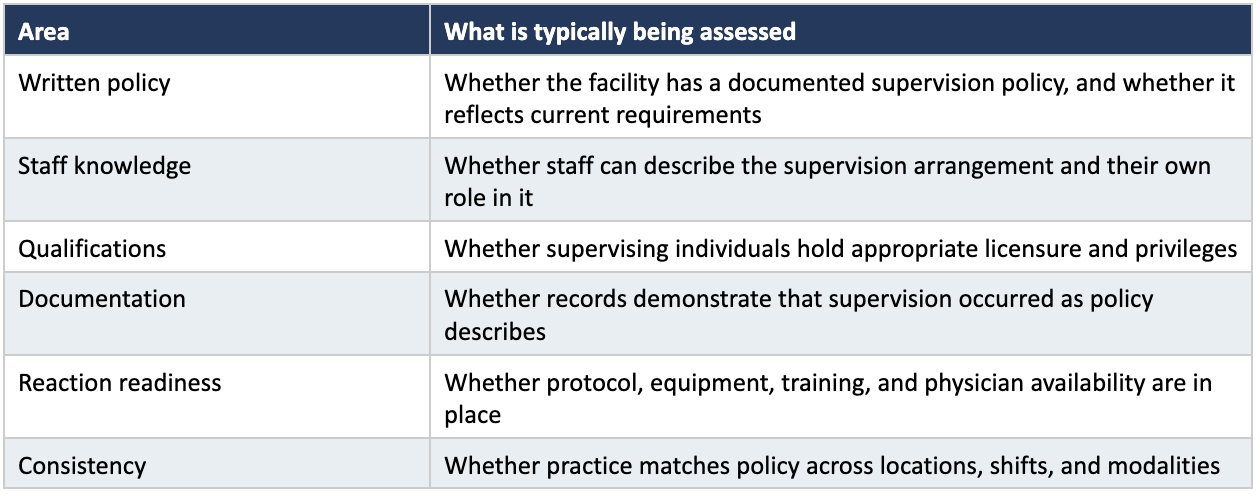
Across organizations, the recurring pattern is that surveyors look for alignment between three things: what your policy says, what your staff do, and what your records show. Supervision-related observations generally fall into these areas:
The last row is where facilities most often stumble. A policy that accurately describes the main site during weekday hours, but not the satellite location on Saturday, is a consistency problem rather than a policy problem — and it is visible in the records.
The Policy-Practice Gap
The most common supervision finding is not that a facility lacks supervision. It is that the written policy and the actual arrangement have drifted apart — usually because the policy was written once and the operation changed afterward. New locations opened, hours extended, coverage arrangements changed, or the rules themselves moved.
This is straightforward to prevent and awkward to explain after the fact. Reviewing the supervision policy whenever coverage arrangements change, rather than only on the accreditation cycle, keeps the two aligned.
Remote Supervision in an Accredited Program
There is nothing inherently incompatible between remote supervision and accreditation. Accreditors are concerned with whether the applicable supervision requirement is met and demonstrable, not with where the physician was standing.
What a remote arrangement should be prepared to show:
- That the policy describes the remote model accurately, rather than describing an on-site arrangement the facility no longer uses.
- That supervising physicians are appropriately licensed and privileged at the facility.
- That the record identifies the supervising physician for specific studies and evidences availability.
- That staff understand the arrangement, including how supervision is established and what to do if the connection fails.
- That contingency handling is defined and staff have practised it.
Of these, staff knowledge is the one most often overlooked. Surveyors talk to people. An arrangement that is sound on paper but which technologists cannot describe reads as an arrangement that is not really operating.
What to Confirm With Your Accreditor
- Which of your accreditor’s standards touch supervision, and what is the current published language?
- Has anything changed since your last survey?
- Does your accreditor have any published position on remote or virtual supervision arrangements?
- What documentation would satisfy a supervision-related inquiry during a survey?
- Do requirements differ across the modalities and settings you operate?
How ContrastConnect Supports Accreditation Readiness
ContrastConnect provides remote physician supervision of contrast administration with the elements accreditation readiness depends on: appropriately licensed and privileged physicians, identification of the supervising physician for each study, records evidencing availability, and defined contingency handling. What remains the facility’s responsibility is the rest of the picture — policy that describes the arrangement accurately, staff who understand it, and on-site reaction readiness.
Trusted Nationwide


















.avif)




1,000,000
Contrast exams supervised annually
75,000+
Hours of supervision monthly
3,900+
Technologists certified
100s
Of imaging partners nationwide
130+
Contrast reactions treated monthly
100%
Requested hours covered
Connect with us.

